|
18th May
|
|
|
|
Andy Burnham's international internet censorship going nowhere fast
|
Based on article from theregister.co.uk
|
Months after announcing his intention to work with the Obama administration to develop new restrictions on unacceptable material online, Culture Secretary Andy Burnham is still waiting for anyone in Washington to listen to him.
At the end
of December, Burnham took to the airwaves and newspaper pages to decry content that should just not be available to be viewed . He also suggested international cooperation to create a system of cinema-style age ratings for English language
websites.
But yesterday in response to a question from the Liberal Democrats, Burnham's junior minister Barbara Follett conceded that four months into the new US administration, no progress had been made on the plans. Officials in London were
still waiting for someone interested to be appointed across the Atlantic, she explained.
I remain keen to discuss an international approach to areas of public concern about certain internet content and look forward to engaging with the
appropriate member of the US Administration once the relevant appointment has been made, Follett said.
|
|
29th March
|
|
|
|
Daily Mail catches Jacqui Smith's husband watching cable softcore porn at the tax payers expense
|
It seems that TV subscriptions are claimable for the 2nd home so no real transgressions beyond the ludicrous porn smear. But as always, the hypocrisy is always funny. Now just need to find a few good quotes from Smith on the subject of men
enjoying 'exploitative' adult entertainment Based on
article from dailymail.co.uk
See also Jacqui Smith under pressure from telegraph.co.uk
|
|
|
|
I wouldn't worry about the press Jacqui,
but Harriet and your man hating mates
aren't going to be very pleased
|
Home Secretary Jacqui Smith's political future was in jeopardy after it was revealed that her husband used her Commons expenses allowance to pay to watch softcore pornographic films.
Richard Timney, who works as Smith's Commons adviser, used
part of the Minister's second-homes allowance to pay for the not so blue movies he watched on a subscription television channel.
Tory MP Philip Davies said last night that if the porn-movie claims were true, the Home Secretary would have to
resign: Claiming that her sister's back bedroom is her main home is one thing but this could push her over the cliff. It is surely not legitimate to use Commons' second-home allowances to buy blue movies. If this is true, I cannot see how she can
survive.
Just three months ago, The Mail on Sunday revealed that Timney – who is paid £40,000 of public money a year as Smith's to run her Redditch constituency office – was behind a letter-writing campaign defending the Government in
her local paper.
Timney had a series of letters published in the Redditch Advertiser backing Smith's identity card plans and attacking the Tories over schools, without revealing that he was married to the woman responsible for the policies.
The ACA allows MPs to claim for television subscriptions at their second home. Last year, under freedom of information requests, it emerged that Gordon Brown claimed for a Sky TV subscription and television licence.
|
|
28th March
|
|
|
|
Jesse Jackson talks about violent media in UK Parliament
|
Based on article from gamepolitics.com
|
The Reverend Jesse Jackson downplayed the influence of violent media in testimony before the British Parliament's Home Affairs Committee. The committee, which has been investigating knife crime, is chaired by long time video game nutter Keith Vaz.
GamePolitics has transcribed the portions of Jackson's testimony which relate to media violence issues:
Labour MP Martin Salter: Rev. Jackson, we've been taking evidence on the effects or the increasing
effect of violent media images on young people, whether it's in video games, whether it's on TV, whether it's the cinema. It seems the evidence were hearing, that there's a general danger that young people can be desensitized to the concept of violence
by the images that they see, but there's a greater predisposition to violence if those young people are brought up in families and households and communities where actual violence is the norm. Do you have any lessons from America for us on this issue?
Rev. Jesse Jackson: For a long time we challenged music artists and movie makers to be sensitive to the impact that their music and their movies have on children and they have some
force... But those who grow drugs in Afghanistan and poppy seeds – they don't listen to music. This thing is not about music and movies. It's about a form of economy... we've lost more lives from [the drug] war than the war in Iraq and Afghanistan. And
we seem to see it as something marginal but it is in the center of our security and it's getting worse in my judgment... the structural crisis of poverty and drugs and guns is more real than just movies and music.
Labour MP
Keith Vaz: Do you accept that there is a link between violent video games and violence that is perpetrated by individuals? Do you think that those images do have an effect on young people?
Rev. Jesse Jackson: There may be some link of imitation. The question, Mr. Chairman, is art imitating life? Is life reflecting art? There's always a big debate there. What we do know in these troubled times… there's
increased domestic violence in the home. [Children are] more likely to imitate parents fighting physically. Domestic violence is maybe even a bigger factor on violent behavior than the movies and the worst games that are played. So, yes, we urge artists
to not use their considerable skills to desensitize people to violence. Sure, these games that think that killing is a game must be challenged. But the economic impact of life options determines whether one is headed up towards university or down toward
prison.
|
|
28th March
|
|
|
|
West Midlands police censor graffiti mural
|
From muslimnews.co.uk
|
West Midland's police were accused of wanton censorship after it erased a Free Gaza mural by a renowned Muslim graffiti artist. Despite receiving the permission of the property owner police assessed Mohammed Ali's work as a supposed
security risk. The force, which did not receive a single complaint, was also accused of deploying underhanded scare tactics in getting the mural removed by suggesting to the elderly homeowner that it could trigger a petrol bomb attack.
The 30 year-old award winning artist accused police of wanton censorship. He told The Muslim News: The murals are not racist or homophobic and they do not incite violence but the police implied that they could stir up trouble and trigger
violence between Jews and Muslims. Police had approached the homeowner and asked her to withdraw mission for the mural and sign a form authorising its removal. The owner's son Mohammed Azam said: The police arrived out of the blue and told
my mother that the house could be petrol-bombed because of the mural - my mother is scared stiff. I asked them on what a risk assessment was carried out, and the officer at the police station told me his sergeant had seen the mural and decided it should
come down.
Local Jewish bodies backed the mural. Ruth Jacobs, of the Israel Information Centre in Birmingham, said, I would not complain about these images because I see them as part of the right to free speech in this country. They are
actually quite good pieces of art. Birmingham Labour MP, Khalid Mahmood, said he was concerned by the police's action. He said, The murals are expressive and show the emotion of young people about what is going on in Gaza. The police
need to clearly demonstrate that these murals have put somebody at risk.
Lib-Dem Councilor, Tariq Khan, described police claims that the mural may trigger a bomb attack as outrageous.
|
|
27th March
|
|
|
|
Parliamentary internet filter blocks MP's own newspaper column
|
Based on article from news.bbc.co.uk
|
MPs are prevented from surfing the internet for pornographic and other inappropriate material in their Commons offices, it has emerged.
A filter on the Commons IT system blocks access to websites that contain supposedly offensive or
illegal content or are sources of malicious software.
The policy emerged after an MP was unable to access colleague Lembit Opik's column on the Daily Sport site.
Opik said he did not believe the site should be blocked: Because of
the things they are trying to censor they may have made an assumption about this particular website . But he said he did not believe the site was inappropriate and that although he backed the filters, which prevented MPs from being bombarded
with utter rubbish , he did think they were too restrictive and sometimes prevented MPs from accessing sites they needed for their work.
|
|
27th March
|
|
|
|
Ofcom wisely back off from matters of religious 'balance'
|
Based on article from ofcom.org.uk
|
The Qur'an
Channel 4, 14 July 2008, 20:00 The Qur'an was a two-hour documentary made by the film-maker, Antony Thomas. It was broadcast as part of Channel 4's Islam Unveiled season, a week of programmes dealing with
Islam. The Qur'an examined what the Qur'an itself says on a range of issues such as crime and punishment, violence and conflict, and the treatment of women. The programme attempted to relate present-day Islamic practice and beliefs to the Qur'anic
source text.
The programme contained several sequences discussing Shi'a practice and beliefs. In particular, it focussed on “intercession”. Intercession is the practice of directing prayers and requests to God through certain members of the
family of the Prophet Mohammed. This includes Imam Ali Reza and his descendents, the eighth of the twelve Imams who are perceived by some to be the religious and political successors to the Prophet Mohammed.
Ofcom received 21 complaints from
individuals on the grounds that it portrayed Shi'a Muslims in a negative, unbalanced and irresponsible light , with a series of misrepresentations of the Qur'an's teachings. Ofcom also received a detailed complaint from 12 organisations
representing Shi'a Islam within the UK. Based on article from broadcastnow.co.uk The complainants said the film risked increasing tensions within the Muslim community between Sunnis and Shi'as, and inspiring violence against
Shi'as. They also chastised it for not using Shi'a scholars and commentators in the UK and for giving insufficient time to Shi'a contributors in general.
Ofcom ruled that the programme did not mislead viewers on Shi'a belief and practices and
that it could not be judged as likely to inspire violence against Shi'as.
The regulator was unable to rule on the grounds of balance, as its remit in this area covers only news and factual output relating to political or industrial controversy or
public policy.
C4 commissioning editor, religion and multicultural Aaqil Ahmed said: Hopefully we can now remember this film for what it was - a truly original piece of landmark television. Antony Thomas and Samir Shah's
amazing efforts to get it made and made so well should be applauded and from now on any film made on the subject will have a remarkable benchmark.
I am pleased that Ofcom has endorsed the views of TV critics, who described The Qur'an as
'scrupulously fair-minded', 'exhaustively researched' and 'an exemplary piece of programme making.
I am grateful that this ruling, by the independent regulatory body responsible for broadcasting, completely dismisses the unfounded allegations
|
|
19th March
|
|
|
|
|
Records released from the National Archive See article from guardian.co.uk
|
|
18th March
|
|
|
|
MPs take pot shots at bad guy Vaz
|
Based on article from
dailymail.co.uk
|
Keith Vaz looked increasingly isolated last night after his position as chairman of an influential Commons committee was called into question by senior MPs.
He is likely to come under pressure to stand down at a meeting of the Home Affairs Select
Committee following revelations in the Daily Mail that he intervened in a court case on behalf of a crooked friend.
In line with Parliamentary convention, members of the committee are refusing to criticise him publicly. But such is the level of
anger that some have sanctioned friends to make their feelings clear. One said last night: Vaz limps from drama to drama and it is about time he looked at his position. Another said that they expected Vaz's conduct to be brought up in a
closed session today, while a third source close to an MP on the committee claimed that the chairman's behaviour stinks.
As the pressure on him increased throughout, Vaz also faced a censure motion from the Commons over claims he abused
his position.
Tory MP Douglas Carswell said: If these press reports are true, Vaz must quit as chairman of the Commons select committee. His position is simply not tenable, and the longer he stays, the more he brings the entire farcical
Commons into yet further disrepute.
Fellow Tory MP Andrew Robathan added: It is entirely inappropriate that the chairman of the Home Affairs Select Committee should write to the Royal Courts of Justice expressing an opinion on a case
before the courts.
Vaz is likely to escape a full-scale sleaze inquiry because he has already been cleared of wrongdoing over his links to Mireskandari by Parliamentary Standards Commissioner John Lyon.
The greatest pressure is likely
to come from colleagues in the Commons, including those on the committee. Vaz did not receive the consent of fellow committee members to make his attempt to help Mireskandari, a convicted conman.
One MP said: If anyone writes in the capacity
of a position on a select committee, then that letter should be circulated so that it has the agreement of the committee as a whole. Failing to do so deserves at the very least a warning and admonishment, and such actions could be considered a sacking
offence.
Vaz has so far refused justify his intervention as select committee chairman.
|
|
17th March
|
|
|
|
Scottish Greens concerned about needless criminalisation
|
From business.avn.com
|
A new Scottish anti-porn bill is being slammed from hill to glen by opponents as more severe than similar English legislation.
S34 of the Criminal Justice and Licensing (Scotland) Bill was published last week and met with a roar of
disapproval.
Like its English cousin, the legislation attacks violent or "extreme" adult content including images of life-threatening acts, non-consensual sex, bestiality and necrophilia.
An exception to the rule is if those who
possess the photos are principal actors engaging in a fantasy, which raises one of several gray areas, say opponents. Becky Dwyer of Consenting Adult Action Scotland has met repeatedly with Scottish officials, to no avail.
The amount of
research this team have put into the issue was pathetic. It hadn't even occurred to them that someone participating in a scene might not be in a photo, she told The Register. Meanwhile, they have given no assurances whatsoever that BDSM safety
material will be excluded on educational grounds. For a government allegedly interested in safety, this is a shameful omission.
Too much Scottish legislation still suffers from outdated and puritanical 'anti-sex' attitudes, said
Scottish Greens leader Patrick Harvie: The law should have a basic respect for the freedoms of consenting adults, and for the diversity of their sexualities.
Harvie is concerned that the government is criminalizing people needlessly.
While I doubt that any radical amendments will gain a Parliamentary majority, I am hopeful that at least some improvements can be made.
|
|
16th March
|
|
|
|
Supporting the hype for Bronson
|
1st March 2009. Based on article from guardian.co.uk
|
A biopic of the criminal Charles Bronson, who has been called the most violent man in Britain, has been condemned for glorifying his life and encouraging copycat behaviour in prisons.
Bronson was made in collaboration with the
notorious inmate, whose real name is Michael Peterson. Promoted as A Clockwork Orange for the 21st century , the film is an unsparing depiction of Bronson's brutal attacks on prison warders, hostage-taking and fights with fellow inmates. He has
spent 29 of the past 35 years in solitary confinement and is now in a specially constructed cage deep inside Wakefield maximum security prison.
It's a sad state of affairs in society when we want to glorify someone who has committed horrendous
acts of crime by making a film about him, said Glyn Travis, assistant general secretary of the Prison Officers Association: Charles Bronson has cost the taxpayer an inordinate amount of money because of his life of crime. This is not a role model
we want to portray for people who come into prisons.
The film's Danish director, Nicolas Winding Refn, insists he has no interest in trying to win sympathy for the 56-year-old criminal. He said he agreed with the view expressed by Travis that
Bronson should not be glorified. The film will be released on 13 March 2009. Update: Christopher Tookey Recommends 16th March 2009. See
article from
dailymail.co.uk , Thanks to Dan
|

|
|
Tookey Recommends...
Bronson
|
British Lottery-funded projects don't come much more barking than Bronson , a heavyweight contender for most unpleasant, ugly and pointless film of 2009.
Danish director Nicolas Winding Refn's ill-advised excursion
into art-house brutalism begins with the actor playing Britain's most violent prisoner saying to the camera: I am Charles Bronson, and all my life I've wanted to be famous.
Well, now he is. That's one of the most obvious gripes about the
movie. In taking a studiously nonjudgmental, fashionably nihilistic line, it will prove to morons the world over that attacking people for no reason is one sure fire way to attain celebrity.
Bronson
Why on earth such a creep should be
glorified, I cannot imagine, especially as the film makes no attempt to understand him or derive any lessons from his behaviour.
In addition to celebrating violence, this most brutal of biopics is virulently homophobic. And its other disagreeable
overtones of pretentiousness and precious fringe-theatricality make it a uniquely gruesome experience.
Especially distasteful is the use of classical music, in the questionable tradition of Stanley Kubrick's A Clockwork Orange, to add a pretence
of ironic nobility to Bronson's thuggishness.
Verdict: Could be a big hit... among psychopaths
|
|
15th March
|
|
|
|
Nutters get wound up by teen magazines featuring articles on sex
|
Presumably the teen consumers enjoy their magazines. How come someone working for 'Consumer Focus' is supporting the nutters who want to ban them From telegraph.co.uk
|
Ed Mayo, chief executive of Consumer Focus, a government quango, said the magazines were pushing the envelope and warned that parents would be shocked by much of their content.
An article by the Sunday Telegraph featured several
magazines aimed at teenage girls and found that they contained sexually-explicit material which was potentially in breach of the industry's editorial code.
Bliss magazine, whose readers have an average age of 15, features on the front of this
month's issue the cover lines The Sex Factor and Gang raped – for a mobile phone.
April's Sugar magazine, with readers aged 14 on average, features a spread entitled Is it a crush or are you gay? . This month's Top of the
Pops Magazine, with readers aged 11 to 15, is sold with a set of Kiss Me! stickers.
The Teenage Magazine Arbitration Panel (TMAP), the industry's self-regulatory body whose members include publishers and editors, is tasked to ensure that
the sexual content of teenage magazines is presented in a responsible and appropriate manner.
However, critics say that few parents know about TMAP. Since it was launched in 1996, to head off the threat of legislation clamping down on the
magazines' sexual content, it has ruled on only three complaints, and in the past three years it has received only one.
Mayo said: Teenage magazines do have a role to play in guiding teenagers through difficult issues, but
when it comes to what is responsible and what is not, clearly the envelope is being pushed and parents would be shocked by much of their content.
There is no doubt that some of these magazines are responsible for the early sexualisation of
children. If you let industry set the rules, the industry will often find a way through. The answer is not always new rules, but I would welcome the current guidelines actually being enforced.
Michael Gove, the shadow children's secretary,
said: These magazines are pushing the boundaries of what parents would consider acceptable. Their publishers have to explain why publications aimed at girls below the age of consent carry this sort of material. The industry needs to
look again at how it regulates itself.
Sue Palmer, an educational consultant and the author of Toxic Childhood, said: The reality is that children as young as 10 read these magazines, and what they are being exposed
to is often horrific and entirely inappropriate. The very blatantly sexual ethos expressed in them is becoming normalised among young girls. Then we wonder why we have such high teenage pregnancy rates and a booming ladette culture. The regulatory body
is clearly a toothless watchdog. Magazines are blatantly flouting the guidelines, which need to be tightened up and have a real force of law behind them, with a watchdog that is independent of the industry.
|
|
14th March
|
|
|
|
Scottish Government publishes its extreme pornography bill
|
From scottish.parliament.uk
|
The Scottish Government have decided to amend its existing obscene publications law rather than create a new standalone law. 34 Extreme pornography
(3) A person guilty of an offence under this section is
liable— (a) on summary conviction, to imprisonment for a period not exceeding 12 months or to a fine not exceeding the statutory maximum or to both, or
(b) on conviction on indictment—
(i) in a case where the obscene material is or includes an extreme pornographic image, to imprisonment for a period not exceeding 5 years or to a fine or to both, or
(ii) in any other case, to imprisonment for a
period not exceeding 3 years or to a fine or to both.
51A Extreme pornography (1) A person who is in possession of an extreme pornographic image is guilty
of an offence under this section.
(2) An extreme pornographic image is an image which is all of the following— (a) obscene,
(b) pornographic,
(c) extreme.
(3) An image is pornographic if it is of such a nature that it must reasonably be assumed to have been made solely or principally for the purpose of sexual arousal. (4) Where (as found in the
person's possession) an image forms part of a series of images, the question of whether the image is pornographic is to be determined by reference to— (a) the image itself (and any sounds accompanying it),
and
(b) where the series of images (and any sounds accompanying them) is such as to be capable of providing a context for the image, its context within the series of images.
(5) So, for example, where—
(a) an image forms an integral part of a narrative constituted by a series of 10 images, and
(b) having regard to those images as a whole, they are not of such a nature that they must reasonably be
assumed to have been made solely or principally for the purpose of sexual arousal, the image may, by virtue of being part of that narrative, be found not to be pornographic (even if it may have been found to be pornographic where taken by itself).
(6) An image is extreme if it depicts, in an explicit and realistic way any of the
following— (a) an act which takes or threatens a person's life,
(b) an
act which results, or is likely to result, in a person's severe injury,
(c) rape or other non-consensual penetrative sexual activity,
(d) sexual activity involving (directly or indirectly) a human corpse,
(e) an act which involves sexual
activity between a person and an animal (or the carcase of an animal).
(7) In determining whether (as found in the person's possession) an image depicts
an act mentioned in subsection (6), reference
may be had to— (a) how the image is or was described (whether the description is part of the image itself or otherwise),
(b) any sounds accompanying the image,
(c) where the image forms an integral
part of a narrative constituted by a series of images, the context provided by that narrative.
(8) A person guilty of an offence under this section is liable—
(a) on summary conviction, to imprisonment for a period not exceeding 12
months or to a fine not exceeding the statutory maximum or to both,
(b) on conviction on indictment, to imprisonment for a period not exceeding
3
years or to a fine or to both.
(9) In this section, an “image” is— (a) a moving or still image (made by any means), or
(b) data (stored by any means)
which is capable of conversion into such an image.
51B Extreme pornography: excluded images (1) An offence is not committed under section 51A if the image is an excluded
image.
(2) An “excluded image” is an image which is all or part of a classified work.
(3) An image is not an excluded image where— (a) it has been extracted from a classified work, and
(b) it must be reasonably be assumed to have been extracted (whether with or without other images) from the work solely or principally for the purpose of sexual arousal.
(4) In determining whether (as
found in the person's possession) the image was extracted from the work for the purpose mentioned in subsection (3)(b), reference may be had to— (a) how the image was stored,
(b) how the image is or was
described (whether the description is part of the image itself or otherwise),
(c) any sounds accompanying the image,
(d) where the image forms an integral part of a narrative constituted by a series of images, the context provided by that
narrative.
(5) In this section and section 51C— “classified work” means a video work in respect of which a classification certificate has been issued by a
designated authority,
“classification certificate” and “video work” have the same meanings as in the Video Recordings Act 1984 (c.39),
“designated authority” means an authority which has been designated by the Secretary of State under
section 4 of that Act, “extract” includes an extract of a single image,
“image” and “extreme pornographic image” are to be construed in accordance with section 51A.
51C Extreme pornography: defences (1) Where a person (“A”) is charged with an offence under section 51A, it is a defence for A to prove one or more of the matters mentioned in subsection (2).
(2) The matters are—
(a) that A had a legitimate reason for being in possession of the image concerned,
(b) that A had not seen the image concerned and did not know, nor had any cause to
suspect, it to be an extreme pornographic image,
(c) that A—
(i) was sent the image concerned without any prior request having been made by or on behalf of A, and
(ii) did not keep it for an
unreasonable time.
(3) Where A is charged with an offence under section 51A, it is a defence for A to
prove that— (a) A directly
participated in the act depicted, and
(b) subsection (4) applies.
(4) This subsection applies— (a) in the case of an image which depicts an act described
in subsection (6)(a) of that section, if the act depicted did not actually take or threaten a person's life,
(b) in the case of an image which depicts an act described in subsection (6)(b) of that section, if the act depicted did not actually result
in (nor was it actually likely to result in) a person's severe injury,
(c) in the case of an image which depicts an act described in subsection (6)(c) of that section, if the act depicted did not actually involve nonconsensual activity,
(d) in
the case of an image which depicts an act described in subsection (6)(d) of that section, if what is depicted as a human corpse was not in fact a corpse,
(e) in the case of an image which depicts an act described in subsection (6)(e) of that section,
if what is depicted as an animal (or the carcase of an animal) was not in fact an animal (or a carcase).
(5) The defence under subsection (3) is not available if A shows, gives or offers for sale the image
to any person who was not also a direct participant in the act depicted.
|
|
13th March
|
|
|
|
|
Impacting freedom of expression online See indexoncensorship.org
|
|
12th March
|
|
|
|
Burnham will create co-regulatory censor for Video on Demand services
|
From paidcontent.co.uk
|
Culture secretary Andy Burnham has confirmed he will create a co-regulatory body, led and funded by the industry, to take on responsibility for regulating programme content on video-on-demand services. Under the new rules, all UK providers of
VOD services will need to notify the co-regulator that they are providing a service, Burnham's department for culture, media and sport said. Burnham's announcement signals the UK government's acceptance of most of the provisions in the
European Commission's new Audiovisual Media Services directive (AVMS), drafted in 2007 to replace its 20-year-old Television Without Frontiers rules. AVMS, which is being implemented by EU member states, makes the first regulatory distinction between
linear and on-demand media, which was designated to get only light-touch regulation. Burnham's implementation through co-regulation will throw the spotlight on the existing Association for Television On Demand (ATVOD), which has operated
since 2003 to self-regulate the sector.
Burnham said: Video-on-demand services only come within the scope of the AVMS directive if they are mass media services whose principal purpose is to provide TV programmes to the public on demand.
But technology is changing rapidly and the interpretation already appears out-dated. Not only is YouTube already available on TV sets through Apple TV, Nintendo Wii etc, and not only do services like Joost absolutely want to provide TV shows
on-demand… most web-based VOD services ultimately also want carriage to the TV, too. In appealing to those such services, BBC's Project Canvas, for example, is aiming to make internet VOD mass media , just as Burnham defined.
|
|
11th March
|
|
|
|
Scottish Government publishes its extreme pornography bill
|
Thanks to eMark
See Criminal Justice and Licensing (Scotland) Bill [pdf] from
scottish.parliament.uk
|
Some thoughts:
Serious is replaced with severe - god knows what the difference is.
The law is much broader, including any depiction of rape or other non-consensual penetrative sexual activity - even if it was actually
consensual, an image will be illegal if it looks non-consensual. Part 7 makes it clear that the only context allowed in determining whether it depicts an non-consensual act (or falls under any of the other clauses) is the image itself, any
accompanying sounds, and its context if the image is part of a series of images.
Similarly, much like the English law, the decision of pornography is decided solely by looking at the image, any sounds, and the context if the image is part
of a series of images. So But this image wasn't really produced for the purpose of porn won't help.
The defence for directly participating in consensual acts is there, but not as broad. For threat to life and severe injury ,
the defence only applies if the act did not really involve a threat, or was not really likely to result in severe injury. In practice, this is the same as the English law (where the defence only applies to acts we can legally consent to), however, at
least there is the possibility of a court deciding we can consent to the act. Here, the Government have made up their minds for them, and explicitly left images of consensual acts illegal, unless they are staged.
The defence is also not available
if you show or give the image to anyone who didn't directly participate (even if it's the photographer, or your partner)!
On the plus side, it looks like they have restricted the law to images that would be illegal under Scotland's equivalent of
the Obscene Publications Act? The image must be obscene , and this text modifies the law on publication (so unlike the two-faced English law, it seems they haven't switched to using the dictionary definition?)
|
|
11th March
|
|
|
|
Well known figure objects to phrase in book
|
Based on article from telegraph.co.uk by Richard Eden
|
Two years after it was published to great acclaim, Andrew Marr's bestseller A History of Modern Britain has been urgently recalled from bookshops amid great mystery.
Pan Macmillan has issued an urgent stock recall notice in
which it said that shops needed to return all unsold copies immediately for unspecified legal reasons.
I understand that the recall is because of a complaint by a very well known figure who objected to one silly little phrase
in the book.
It's quite unbelievable, says my bookworm. Because of one tiny phrase, which is hardly the world's biggest libel, a book which has already been been bought by 250,000 people has to be pulped. I've never known anything like
it.
Anthony Forbes Watson, the managing director of Pan Macmillan, refuses to elaborate on the legal issues surrounding the recall of Marr's book. It is believed that the publisher intends to re-issue it when the changes have been made
The Angry Brigade 11th March 2009. Thanks to Floyd. See article from
en.wikipedia.org Unsold copies of the book, a best seller, were recalled in March 2009 when it emerged legal action had been taken out against the book for false claims that
women's rights campaigner Erin Pizzey had been a member of The Angry Brigade terrorist group.
|
|
11th March
|
|
|
|
|
BBFC film examiner talks about censoring porn See article from indexoncensorship.org
|
|
11th March
|
|
|
|
Richard Taylor suggests violent video game tax
|
Based on article from telegraph.co.uk
|
Gordon Brown should levy a tax on violent video games to help tackle knife crime, according to the Richard Taylor, the father of murdered schoolboy Damilola Taylor.
Taylor, who advises Gordon Brown on knife crime, said he would be urging the
Prime Minister to impose new taxes on the games Violent games are too cheap and taxes on them should be very high, Taylor told MPs of the Home Affairs Committee: I have young people who I mentor and I see them go up and buy the
games and it saddens me that they are being able to have such a negative impact.
Taylor also told MPs that he was concerned about the content of much rap music: It is creating more of a problem because of the language that is used. It is
language that, as a father, I would not allow my children to hear. To me, there is a lot of negativity that comes out of this music, especially that which is coming from America.
Taylor became Brown's special envoy on youth violence and knife
crime last month. Part of his role is to offer new ideas to the Premier on how to change young people's behaviour. Violent Video Game Tax Discussed in Pennsylvania Based on article from gamepolitics.com
GamePolitics recently covered a committee hearing of the Pennsylvania House of Representatives. The topic was violent video games .
State Representatives question employees of the Pennsylvania Joint State Commission as to possible
alternatives by which violent video games might be targeted. One suggests that a 5% tax be levied on sales of violent games with proceeds used to fund a parental education program. A second ponders whether state tax incentives could be withheld from
companies which create violent games.
Overall, the meeting was largely exploratory and action on either the 5% tax idea or the restriction on financial incentives seems unlikely. Comment:
Reactionary Bollox From Dan You would think that the tragic loss this man has suffered would make him want to refrain from pandering to the kind of sensationalist reactionary bollox that is pushed by
the tabloids.
I hope video game fans oppose a tax on their consumer choices
|
|
10th March
|
|
|
|
Censorship stats: BBFC cut 27% of R18s in February 2009
|
Thanks to Sergio on the Melon Farmers Forum
|
BBFC R18 cuts for February 2009 Number of items= 59
No. Cuts=16
Cuts ratio=27% The R18 cuts stats 2009:
- January: 12 R18s cut out of 62 (19%)
- February 16 R18s cut out of 59 (27%)
Cuts of interest:
Mistress Dometrias' Brighton Dungeon
Cuts were required to remove potentially harmful, potentially obscene, and abusive elements from an R18 BDSM work
(in this instance, use of wax on genitals, wounding of genitals, asphyxiative practices, a rape reference and gagging during fellatio). Cuts made in accordance with BBFC Guidelines and policy, the Video Recordings Act 1984, and current interpretation of
the Obscene Publications Act 1959.
|
|
5th March
|
|
|
|
Comedy documentary passed 15 uncut by the BBFC
|
See article from bbfc.co.uk
|
The new 'documentary' by the man behind Borat has been passed 15 uncut by the BBFC. Provocatively titled Religulous (think 'religious' and 'ridiculous'), it will mock the beliefs of the world's major religions, recruiting unwitting
assistance from the ranks of the faithful. The BBFC helpfully explained their decision: Religulous is a documentary by Bill Maher, an American comedian, on the beliefs and practices of the major religions. It
was passed '15' for strong language, drug use and sexualised nudity.
The film questions the tenets of all the major religions in a mocking fashion but with some serious intentions underlying it. A number of the dialogues contain strong language
and one quite explicitly refers to paedpohilia involving Catholic priests. As part of his global exploration Maher conducts several conversations in a Dutch coffee house and samples a marijuana cigarette. BBFC Policy and Guidelines allow for scenes of
drug taking at '15', but does not allow the promotion of illegal drug use at any category. This film, as a whole, does not promote or encourage drug use.
As part of the ironic style of the film, excerpts from unrelated and dated features are inserted
in order to make humorous statements. Examples of these include soft porn style shots of a naked man and another caressing a naked woman. The film also contains some strong dialogue references to sex acts. More conventional techniques include the
insertion of reality footage of terrorist attacks, including 9/11, the London bombings and sight of the corpse of the Dutch film maker Theo Van Gogh.
|
|
26th February
|
|
|
|
|
Why is the BBFC so scared of arousal? See article from spiked-online.com
|
|
24th February
|
|
|
|
National Theatre play winds up the stereotyped
|
Based on article from guardian.co.uk
|
It has incestuous, pig-breeding, drunken Irishmen, snooty Frenchmen, farcical Jewish anarchists and the animated presence of a mad mullah ranting about how women must be subservient to men. It reminded the Daily Telegraph of the Carry On films
and the London Evening Standard of the slick, cruel, abusive style that Bernard Manning perfected ages ago.
Its director and writer may well have anticipated controversy, but shortly after opening at the National Theatre, England People
Very Nice , a new play by the award-winning dramatist Richard Bean about successive waves of immigration to the east end of London, has been labelled racist and offensive by the communities it portrays.
A delegation of writers and community
activists from the East End will meet on Friday with Nicholas Hytner, the National's director who is also directing the play, to protest against what they regard as a caricature of Britain's racial history.
The National represents modern
Britain, and in particular London, and I don't see how Muslims can identify with the National Theatre when it puts on this kind of racist work, Hussain Ismail, a playwright from Bethnal Green who has demanded the meeting with Hytner, told the
Guardian: I have been going to the National for 20 years, but I don't see how I can identify with a place that stages what I see as a personal attack on me and the community I belong to.
Hytner said in a statement: The play lampoons all
forms of stereotyping: it is a boisterous satire of stereotypes of French, Irish, Jews, Bangladeshis, white East End cockneys, Hampstead liberals and many others. Every stereotype is placed in the context of its opposite and it clearly sets out to
demonstrate that all forms of racism are equally ridiculous.
Bean's comedy, set around the Brick Lane area of east London, spans more than three centuries, from the arrival of Huguenot weavers to successive influxes of Irish, eastern European
Jews and Bangladeshi Muslims. Each wave is greeted with hostility and suspicion with locals, only to integrate to such an extent that they themselves take a similar attitude to the next wave of newcomers. Update:
Multicultural Censors Organise Protest 24th February. From islamophobia-watch.com Artists from the East End will be holding a protest outside the National Theatre at 5pm on Friday 27th February
in the run up to the platform discussion at 6pm with Richard Bean, the writer of the play. Playwright Hussain Ismail, who will be leading the campaign, said: Hytner is scared of a debate. We are from the East End and we know that it is the most
multicultural place in the world. Brick Lane in particular is the centre of the multicultural universe. It's the coolest place on the earth and that's why people come from all over the world to hang out there. Bean and Hytner haven't got a clue about the
East End. That's why the play is bonkers!
We want a right of reply a proper debate not a 40 minute platform discussion where the director just asks some bland questions to the writer and we all go home. We want a vigorous and robust
debate with Bean and Hytner and us on the same platform with the media and public present on mass.
Organisers of the protest are asking everybody to come celebrate multicultural London and demand that East End artists have the right to a
debate, and challenge misrepresentation of their communities. They are asking protesters to bring whistles and drums to stand up for multiculturalism.
|
|
23rd February
|
|
|
|
BBFC examiners resisting solo viewing for sex works
|
Based on article from guardian.co.uk
|
Staff at the BBFC are in revolt over a management plan that would require them to watch hardcore pornographic films alone in a bid to save money.
The BBFC employs about 80 examiners, who currently watch explicit films in pairs, but executives
want to extend solo viewing, which has already been introduced for less controversial content. Films released at theatres are still watched by more than one examiner, and sex works are also viewed in pairs. Examiners argue that working in teams
make it easier to form a professional judgment about content.
Examiners say films that are refused an R18 certificate often include scenes that many find disturbing, including sadomasochism and sexual violence. Some are concerned that viewing
pornographic content alone will increase the chances of being sexually aroused by the material.
Insiders say the changes are motivated by cost cuts. The BBFC is a not-for-profit organisation funded by the film and TV industries, whose members pay
a fee for each product licensed. The BBFC classifies about 600 cinematic releases and 12,000 DVDs each year.
A spokeswoman for the BBFC said its examiners already view most content alone, although some of it is still watched either by a team or
by more senior staff. She confirmed that sex works are currently examined by teams of two, but added that a final decision on the proposed changes had not been taken.
The BBFC is currently consulting staff about a proposal that sex works
should also be examined by examiners viewing alone, but only on the basis that an appropriate policy is in place for having works which are particularly problematic or unpleasant viewed by teams. Difficult or unpleasant issues or material are not
confined to sex works.
|
|
23rd February
|
|
|
|
IWF talk about lessons learnt from the album cover blocking on Wikipedia
|
From europenews.dk
|
Peter Robbins, chief executive of the IWF, answered questions from ZDNet UK about the fallout from the decision to block the Scorpions album cover on Wikipedia: What issues are there with people's perceptions of what the
IWF does? Surely it's generally agreed that blocking child sexual abuse images is a good thing?
Yes, but the suspicion is about what else is on the [block] list. In the light of the Wikipedia incident, there is a deep suspicion of
what's on the list. How do people know it's indecent images of children being blocked and not, say, politically sensitive information? The last thing we want is to have our list compromised by having sites on the list outside of our remit.
Why did you decide to block the Wikipedia image of the Scorpions album cover?
It's about judgements you make about images. On Wikipedia there was an image of a prepubescent girl with no clothes on posing
provocatively, and that fails UK guidelines. However, the image has been around for a long time.
If the image was provocative, why did you unblock it?
We didn't want to be arguing about the legality of
blocking it if people were proliferating the image, copy and pasting it. We wanted to get back to our core business of notice and takedown, to get to websites around the world.
Will you change how you assess images in the
light of the Wikipedia incident?
We are going to change our systems to deal with the context and the history of the image, and whether the content is available on an innocent site. We learnt lessons from this.
|
|
15th February
|
|
|
|
|
Jacqui's jihad on web extremism flops See article from theregister.co.uk
|
|
14th February
|
|
|
|
Fitna shown in the House of Lords but without Wilders
|
|
|
Dangerous Texting Thanks to Alan I read in Private Eye, just hours after watching Lord Ahmed sounding off about Wilders, that a Lord Ahmed is awaiting sentence for dangerous driving, having killed a
bloke while simultaneously driving and texting.
Bit worse than being rude about some bloke who's been dead 1500 years, I think. Update: Labour Ahmed was sentenced to 12 weeks jail for dangerous driving.
Dangerous Hypocrisy See article from
independent.co.uk by Joan Smith In the past, Lord Ahmed has shown himself to be a selective friend of free speech, hosting a book launch at the House of Lords in 2005 for
a notorious anti-Semite who calls himself Israel Shamir. Last month, a Pakistani press agency reported that a screening of Mr Wilders' short film Fitna at the House of Lords had been called off after Lord Ahmed and representatives of the MCB met
government leaders. When Lord Ahmed discovered that the screening was to go ahead, he said he had received threats and asked the Government not to allow Mr Wilders into the country. Dangerous Text From
geertwilders.nl As Jacqui Smith deemed it necessary to ban Geert Wilders from addressing the House of Lords, he has posted his prepared speech on his website
Thank you for inviting me. Thank you Lord Pearson and Lady Cox for showing Fitna, and for your gracious invitation. While others look away, you, seem to understand the true tradition of your country, and a flag that still stands for
freedom.
...
Thank you very much for letting me into the country. I received a letter from the Secretary of State for the Home Department, kindly disinviting me. I would threaten community relations, and therefore public security in the
UK, the letter stated. For a moment I feared that I would be refused entrance. But I was confident the British government would never sacrifice free speech because of fear of Islam. Britannia rules the waves, and Islam will never rule Britain, so I was
confident the Border Agency would let me through. And after all, you have invited stranger creatures than me.
... By letting me speak today you show that Mr Churchill's spirit is still very much alive. And you
prove that the European Union truly is working; the free movement of persons is still one of the pillars of the European project.
...
Ladies and gentlemen, the dearest of our many freedoms is under attack. In Europe, freedom of speech is
no longer a given. What we once considered a natural component of our existence is now something we again have to fight for. That is what is at stake. Whether or not I end up in jail is not the most pressing issue. The question is: Will free speech be
put behind bars? ...
Geert Wilders MP
|
|
13th February
|
|
|
|
Fitna shown in the House of Lords but without Wilders
|
From thescotsman.scotsman.com
|
The film by a Dutch MP who was refused entry to the UK over fears he would incite hatred with his message about Islam, was shown twice at Westminster last night. The first screening of Geert Wilders Fitna was in the House of Lords and attended by
about 30 people. No MPs and only five peers attended, although organisers blamed poor attendance on the fact parliament rose for a week's recess earlier this afternoon.
A second screening, which Wilders had been planning to attend, was held later
in the evening, for the press, including journalists from the Netherlands. The 17-minute production quotes five Suras, or verses, from the Koran which apparently support violence against non-Muslims.
Wilders, a member of Holland's Freedom Party,
had wanted to show the film to British MPs, but on Tuesday received a letter from the government warning he was not welcome because his views would threaten community security and public security in the UK. The 45-year-old tried to defy the ban,
but was turned back at Heathrow after three hours.
Crossbench peer Baroness Cox, hosting the screening for the press near to the Houses of Parliament, said she did not agree with everything the film suggested, but that Mr Wilders had a right to
defend it.
Muslim groups were divided on whether to bar Wilders.
Mohammed Shafiq, chief executive of the Ramadhan Foundation, backed the government's decision to keep Wilders out of Britain, accusing Wilders of inciting religious hatred:
Mr Wilders film is all about demonising and attacking Islam and Muslims .
But the Quilliam Foundation, a Muslim think tank devoted to fighting extremism, said he should have been allowed into the country so that his views could be
challenged through debate and argument.
The Muslim Council of Britain said in a statement : We have no problem with the challenge of criticisms to our faith ...BUT... the film that will be screened tomorrow by Lord Pearson and
Baroness Cox is nothing less than a cheap and tacky attempt to whip up hysteria against Muslims. They went further and called for Lords hosting the event to be sacked: Mr Wilders' xenophobic and repugnant views have been identified by a
Dutch court, and are now confirmed by his official exclusion to the United Kingdom. It is now time to ask why Peers of Realm who promote such demagogues without any censure are allowed to be regarded as mainstream, responsible leaders in our community.
|
|
13th February
|
|
|
|
Social Services consider legal action to ban Boys and Girls Alone
|
Based on article from
dailymail.co.uk
|
Social services are considering legal action to stop the final two parts of the Channel 4 documentary Boys And Girls Alone being aired.
The four-part series involves a group of children aged from eight to 11 who are left to their own
devices in isolated cottages in Cornwall.
Two episodes of the programme have so far been broadcast and include scenes of children fighting and crying.
Now Cornwall County Council's assistant director for social care and family services
has written to both Channel 4 and Ofcom calling for the final two programmes to be axed due to serious concerns of emotional and psychological abuse.
Ruby Parry said her department would have intervened to safeguard the children had they
been made aware of their circumstances at the time it was recorded. She also said the programme makers breached performance licensing legislation as one of the children involved is from Cornwall but a performing licence was not obtained from the county
council. Parry said as any application for a licence would have resulted in detailed enquiries about the nature of the programme she 'can only surmise that this was a deliberate omission'.
Andrew Mackenzie, head of Factual Entertainment at
Channel 4, denied they had breached performance licensing legislation as the children are not performing but are being observed.
Mackenzie said that Channel 4 regards children's welfare 'as our first priority when filming' and all
programmes are made in consultation with the relevant Ofcom guidelines. He said: All the children were carefully chosen and screened by appropriately qualified experts, including a clinical psychologist, to make sure they could cope well with the
experience of being in the series. The response from the parents and children to the series has been a very positive one. The mums and dads have learnt a huge amount about their children from having the opportunity to see them in this way. Furthermore
many parents report more confident and able children following this stimulating and happy experience.'
|
|
11th February
|
|
|
|
Home Office bans Geert Wilders invited to show Fitna in the House of Lords
|
From telegraph.co.uk
|
Geert Wilders has been refused entry to the United Kingdom to broadcast his controversial anti-Muslim film Fitna in the House of Lords.
Wilders said he had been told that in the interests of public order he will not be allowed to come
to Britain.
He responded to the decision in fighting mood, telling reporters that he still intended to travel to London.
He said: I shall probably go to Britain anyway on Thursday. Let us see if they put me in chains on arrival. It is
an unbelievable decision made by a group of cowards.
The film features verses from the Koran alongside images of the terrorist attacks in the US on 11 September 2001, Madrid in March 2004 and London in July 2005. The film equates Islam's holy
text with violence and ends with a call to Muslims to remove hate-preaching' verses from the Koran.
Last night, Dutch Foreign Minister Maxime Verhagen said he had called British foreign secretary David Miliband to protest against the
decision.
He said: It is disgraceful that a Dutch parliamentarian should be refused entrance to an EU country.
A spokesman for the Lords said that the invitation to show his film remained open.
Home Office sources confirmed Mr
Wilders had been refused entry to the UK.
A Home Office spokesman told The Daily Telegraph: The Government opposes extremism in all its forms. It will stop those who want to spread extremism, hatred and violent messages in our communities from
coming to our country. That was the driving force behind tighter rules on exclusions for unacceptable behaviour that the Home Secretary announced on in October last year.
|
|
11th February
|
|
|
|
New censor on the block has a whinge about Playboy merchandising
|
Based on article from
dailymail.co.uk
|
Consumer Focus has applauded WH Smith for ditching Playboy stationery, claiming pornography was becoming a feature of the playground.
Ed Mayo, chief executive of Consumer Focus, spoke out after WH Smith discontinued the pencil cases and folder
bearing the famous bunny ears logo.
Mayo said stocking the Playboy items was part of a wider sexualisation of children and represented the continuing loss of youngsters' innocence. It was all part of a warped bombardment of children's
lives with adult sexuality which could lead to mental problems in the young, he said.
In some senses it may seem harmless, but we know the stationery range was purchased by primary and secondary school girls - in other ways it's the tip of the
iceberg. We know from research we did that young people like the brand but know it's connected with pornography and becomes a feature in the playground. One 14-year-old said 'It's posh, makes you feel good but it's pornography'. I am delighted WH Smith
have done the right thing.
Mayo also spoke out about the dangers sexualisation of young girls yesterday, warning it triggers 'emotional distress, anxiety, low self-esteem and eating disorders'. Describing the consequences of exposing children
to adult sexuality as dire today, Mayo said: There is a wider exposure of children to things and it's about too much, too young. Early sexualisation on children has a real impact in terms of mental distress.
WH Smith would not be drawn on
whether the decision to withdraw the Playboy merchandise was because of pressure. A company spokesman said: We continually review and update our range to offer our customers a wide range of products. Each spring we renew our range of fashion
stationery and as part of this update we have chosen to discontinue the Playboy range.' Consumer
Focus is a government funded statutory organisation, created through the merger of three organisations – energywatch, Postwatch and the National Consumer Council which:
- establishes a new body to provide a stronger, more coherent consumer advocacy body – Consumer Focus – able to address consumer issues across different sectors, undertake cross-sectoral research, and provide a voice for consumers
in dialogue with companies, regulators, Government and Europe
- extends redress schemes to all licensed energy suppliers and postal services providers to resolve complaints where suppliers and service
providers have not been able to do so, and provide compensation for consumers where it is appropriate
- enables Consumer Direct to become the single point of contact for all consumers to obtain information
and impartial advice as well as signpost consumers and provide them with help when making a complaint. Consumer Direct is a government-funded telephone and online consumer advice service offering clear, practical and impartial consumer advice (08454 04
05 06). Go to Consumer Direct website
Sounds like a another bunch of good for nothing moralising censors to me
|
|
10th February
|
|
|
|
Ofcom dismiss suggestions that Swedes are less offended by strong language
|
From ofcom.org.uk
|
Penn & Teller: Bullshit!
TV6 Sweden, 27 September 2008 at 19:55
ITV6 is a Swedish language channel licensed by Ofcom but restricted to Swedish viewers
Penn & Teller: Bullshit! is a US entertainment series, originally
broadcast on the US subscription channel Showtime. The series is hosted by the two American comedians/magicians Penn Jillette and Teller (known as Penn & Teller). The programme is described on the official Showtime website as a “high-octane, weird,
wacky, entertaining journey through some bizarre territory that no one else is brave enough to touch” and aims to cause controversy by applying Penn & Teller's critical approach to various beliefs and philosophies. The episode complained of was called
War on Porn and was broadcast in English with Swedish subtitles.
Ofcom received a complaint from a Swedish viewer about the sexual content included in the programme. The viewer was particularly concerned that the programme was inappropriately
scheduled before the watershed on a Saturday evening, when young children were likely to be watching.
The programme featured frequent, but brief, clips of adult sexual content. These included shots of men and women simulating sexual intercourse,
women touching themselves and other women in a sexual manner, shots of naked breasts and footage of an adult industry convention - including shots of sex toys, such as dildos and whips.
The programme also contained varying levels of offensive
language. It was broadcast in English with Swedish sub-titles. The original sound-track in English contained several uses of the word “fuck” together with references to “cunt” and “motherfucker.” It also featured milder language such as,
“dick”,“tits”,“cock”, and “pissed”.
The English translation of the Swedish subtitles indicated that they also included references to the word “fuck” and “cunt”, together with references to milder language, such as “cock” and “tits.” Viasat
said with regard to the offensive language featured in the programme, the broadcaster pointed out that although the language is offensive in English the same words are not regarded as offensive in Swedish. It stated that, although English offensive
language is used throughout the programme, the majority of this offensive language was either not translated into Swedish or translated into mild or inoffensive language in the subtitles. Viasat also highlighted that the broadcast of offensive language
in Sweden is not restricted to post-watershed programmes, and the viewer expectations of a Swedish audience are different from those of an English speaking audience. Viasat therefore believed the programme was suitable for the time of broadcast with
regard to language.
Concerning the sexual content, however, Viasat acknowledged that the scheduling of the programme was in breach of its compliance procedures.
Ofcom Decision
Ofcom recognises
that Swedish audiences may have different expectations regarding the use of offensive language before the watershed. However, Viasat is a broadcaster licensed by Ofcom and therefore it is required to comply with its licensing obligations in the United
Kingdom . This includes ensuring that all of its broadcast output complies with the Code. Rule 1.14 of the Code states unequivocally that the most offensive language must not be broadcast before the watershed… Ofcom therefore concluded that the
broadcast of “fuck” and “cunt” before the watershed was clearly unacceptable.
Ofcom noted Viasat's acknowledgement that the programme was broadcast at an inappropriate time and so also found Viasat in breach of rules on that score too.
|
|
8th February
|
|
|
|
Whinging at book shops selling books with 'fuck' in the title
|
Based on article from dailymail.co.uk
|
Tesco and Asda were 'condemned' for selling a string of books and CDs with the F-word in their titles.
The items were available on their websites, where they were easily accessible to children.
Asda quickly apologised when The Mail on
Sunday brought the books and CDs to its attention and promptly removed them from its stock list.
Tesco explained that its technological filter system, designed to prevent any products with offensive titles from appearing on its main site, had
been faulty. It has since been repaired, making the titles more difficult to view.
But nutter MPs and campaigners are now questioning whether a change in the law is necessary to prevent unlimited access to such products.
Don Foster, the
not so Liberal Democrat MP for Bath, criticised falling standards of decency among retailers. He said: In terms of magazines, CDs and DVDs, standards seem to be slipping. If the industry can't collectively sort itself out then we must seriously look
into external regulation. If they can't regulate themselves, we may have to introduce a statutory code.
Nadine Dorries, the Conservative MP for Mid Bedfordshire, questioned how selling adult material fitted in with Tesco's image as a
family supermarket. Is this the beginning of Tesco's drive to dominate the entire retail industry by abandoning all moral boundaries? Is this Tesco's first step into the adult retail market? What kind of supermarket with a shred of moral
responsibility allows such products to be sold openly on the internet, available to children, possibly without a parent's knowledge?
The two supermarkets are not alone in featuring controversial titles on their websites. Last week WHSmith had
23 titles containing the F-word while Waterstone's had 38.
This widespread availability reflects the lack of regulation on the display of such goods on the internet. As the products are legal to sell, the stores themselves agree on a code of conduct
over their availability.
Both Tesco and Asda said they did not sell books with the 'fuck' in the titles in their supermarkets.
Tesco Direct had more than ten books and CDs on its site with the F-word in the titles. These included How
To Fuck A Woman's Brains Out . Other examples were The Fuck-Up , an American novel about a hopeless New Yorker; and Fuck It: The Ultimate Spiritual Way , a self-help book written by an ex-advertising executive turned holistic healer.
A Tesco spokesman said: We block material which may cause offence so that titles like these cannot be searched for or accidentally found. Unfortunately our filter process was not working properly but has now been fixed. We're grateful this was
brought to our attention as we do take this responsibility seriously. With Tesco's filter system, the only way to buy a book with an offensive title is to find out its ISBN – a unique identifying code – and enter that in the site's search engine.
Asda's website is monitored by a third party, which removes from sale anything deemed to be offensive.
Last night, however, both supermarkets' websites were still offering books whose titles use f**k starred out.
John Beyer of campaign
group Mediawatch-uk said the products were legal to sell. But he described the law as ineffective and stressed that retailers had a duty to protect shoppers. He said: Sellers have a wider responsibility to the community they serve. Having that
word in the title on full display is not something you'd expect of a supermarket.
|
|
8th February
|
|
|
|
Jeremy Clarkson explains his apology
|
Based on article from scotlandonsunday.scotsman.com
|
|
|
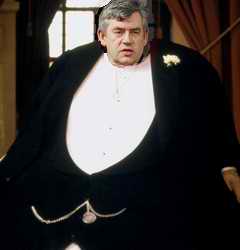
At least he didn't call me fat!
|
Jeremy Clarkson watered down his apology yesterday for calling Prime Minister Gordon Brown a one-eyed Scottish idiot – saying he was not sorry for the idiot bit.
Speaking to The Sun, in which he writes a weekly column, he said:
I very specifically apologised for making fun of his personal appearance – very specifically.
I have nothing against the Scottish and of course I regret making any remark that might have upset the disabled. But the idiot bit – there is no
chance I'll apologise for that.
The BBC said it would be taking no further action against Clarkson.
|
|
8th February
|
|
|
|
Secularists of the Year: the movers behind the abolition of blasphemy
|
Based on article from secularism.org.uk
|
The National Secular Society's annual award for Secularist of the Year has been awarded jointly to Dr Evan Harris MP and Lord Avebury for their success in getting blasphemy laws abolished.
The prestigious prize was handed over by Professor
Richard Dawkins at a glittering awards ceremony at the Imperial Hotel in central London on Saturday.
Terry Sanderson, president of the National Secular Society (NSS), said: The abolition of the blasphemy law in 2008 was a major coup for the
NSS and a great victory for everyone who values free speech. The ancient laws had not been used successfully since the 1970s, but there were efforts by Christian evangelicals to revive them, and a case was being considered even as the law was abolished.
Sanderson said that Dr Evan Harris and Lord Avebury – both Lib Dems – had engineered a clever parliamentary pincer movement that resulted in the Government being forced into bringing forward its own amendment to abolish the law. Having
elicited the promise from Ministers in the House of Commons that the law would be abolished, Lord Avebury, who has been campaigning against the blasphemy laws for decades, then brought forward his own amendment to ensure that the Government could not
renege on its commitment.
|
|
8th February
|
|
|
|
Al Jazeera TV criticised by MPs for hate speech
|
Based on article from timesonline.co.uk
|
The international television channel al-Jazeera has been criticised by MPs for broadcasting the sermons of a Muslim cleric in which he celebrates the Holocaust and prays for the killing of all Jews.
John Whittingdale, chairman of the House of
Commons Media Select Committee, urged al-Jazeera yesterday to apologise for broadcasting the messages of Yusuf al-Qaradawi and to ban the cleric, one of the network's top hosts, from appearing on screen.
I would hope that anybody who watches
it or is aware of it may change their attitude towards al-Jazeera, he told The Times: I would've thought it is very damaging. Al-Jazeera should apologise.
But the network refused to apologise for Sheikh al-Qaradawi's statements, which
were broadcast on al-Jazeera's Arabic station, saying that it could not control the words and opinions expressed during live broadcasts. Andrew Dismore, the Labour MP for Hendon, condemned al-Jazeera for associating itself with Sheikh
al-Qaradawi — who hosts one of its most popular segments, Shariah and Life — saying the network should not use live coverage as a means of justifying the broadcast of the sheik's comments: If they put on somebody who has known racist views they should
not be surprised what comes out at the other end.
The Board of Deputies of British Jews said: These sermons represent hatred in its purest form and epitomise the worst of Islamist anti-Semitism. The complaints relate to a sermon
and a lecture by Sheikh al-Qaradawi in which he described the Holocaust as a divine punishment and prayed to Allah to kill Jews down to the very last one.
|
|
7th February
|
|
|
|
Jeremy Clarkson apologises for calling Gordon Brown an idiot
|
As pbr said on the forum: Hmm... first intelligent thing Clarkson says... and he apologises for it, funny old world. Based on article from telegraph.co.uk
|
|
|
|
At least he didn't call me fat!
|
Jeremy Clarkson has apologised after referring to Prime Minister Gordon Brown as a one-eyed Scottish idiot. He was speaking in Sydney, Australia where he is hosting Top Gear Live , a stage version of the popular BBC show.
During
a discussion on the economy, he compared Brown unfavourably with Kevin Rudd, the Australia prime minister, who had addressed his country on the scale of the financial downturn.
He genuinely looked terrified. Poor man, he's actually seen the
books, Clarkson said of Rudd.
We have this one-eyed Scottish idiot who keeps telling us everything's fine and he's saved the world and we know he's lying, but he's smooth at telling us.
Lesley-Anne Alexander, chief executive of
the Royal National Institute of Blind People, said: Mr Clarkson's description of Prime Minister Brown is offensive. Any suggestion that equates disability with incompetence is totally unacceptable. We would be happy to help Mr Clarkson understand the
positive contribution people with sight loss make to society. In a statement issued by BBC Worldwide, Clarkson said: In the heat of the moment I made a remark about the Prime Minister's personal appearance for which, upon reflection, I
apologise.
Scottish politicians reacted angrily to Clarkson's remarks. Iain Gray, the Scottish Labour leader, said: Such a comment is really a reflection on Jeremy Clarkson and speaks for itself. Most people here are proud that the Prime
Minister is a Scot and believe him to be the right person to get the UK through this global economic crisis.
|
|
5th February
|
|
|
|
|
Summarising UK government censorship for the US adult industry See article from xbiz.com
|
|
4th February
|
|
|
|
A 2nd chance to show Fitna in the House of Lords
|
Based on article from spectator.co.uk
See also video, Fitna
|
As previously reported, a House of Lords screening of Fitna was blocked after pressure from Muslim groups.
The screening, planned for last Thursday, was cancelled after a meeting between Lord Nazir Ahmed, senior House of Lords figures
and Muslim leaders.
The Associated Press of Pakistan quotes Lord Ahmed terming the cancellation a victory for the Muslim community. However Melanie Phillips is now reporting in the Spectator that Geert Wilders has been re-invited to
speak and screen his film in the Lords later this month. A Supreme Case Based on article from iht.com Meanwhile Wilders has asked the Dutch Supreme Court to halt his prosecution on
hate speech charges for anti-Islamic remarks.
Geert Wilders says the remarks — including labeling the Quran a fascist work and calling for it to be banned — fall within the realm of normal discourse and his prosecution threatens his right
to freedom of speech.
|
|
3rd February
|
|
|
|
A song and a dance about smoking in the movies
|
Based on article from
liverpooldailypost.co.uk
|
|
|
|
Don't smoke pups...
It addles the brain, you may turn
into a Liverpuddlian health nut
|
Anti-smoking campaigners from Liverpool took a musical message to the capital – to win support to get smoking out of youth-rated movies.
Young people from D-MYST, the Liverpool-based youth activists organisation, travelled to London to stage a
protest outside the offices of the BBFC.
And, to grab attention for their Scary Movies protest, they staged a dance performance outside the BBFC offices.
D-MYST have approach-ed the BBFC to arrange a meeting to discuss the issue of
smoking in youth-rated movies – so far without success.
They handed in a letter asking for a meeting in the near future.
SmokeFree Liverpool has also asked the BBFC to use its powers – saying that 3,300 young people in Liverpool are
currently smoking because of images they have seen on the silver screen.
Gideon Ben-Tovim, the chairman of Liverpool PCT, said: We are not saying that old films should be re-rated – simply that new films which contain smoking should not be
seen by under-18s. How simple a proposal is that?
|
|
2nd February
|
|
|
|
|
The other face of 'Digital Britain' See politics.co.uk
|
|
31st January
|
|
|
|
Government villains could make mainstream comics illegal
|
Based on article from telegraph.co.uk
|
New laws supposedly designed to tackle extreme and child pornography could make owning mainstream comics like Batman or Judge Dredd illegal, campaigners claim.
They are protesting against two pieces of legislation. The first, is
the Dangerous Pictures clause of the Criminal Justice and Immigration Act, already in force.
The second is the Coroners and Justice Bill, which is currently passing through Parliament. It will introduce a similar law banning the possession of any
image involving sexual activity and children. For the purpose of the law, an image is said to contain a child if the impression conveyed ... is that the person shown is a child. [ie under 18 years old]
The comic book campaigners claim that if
the new rules are interpreted harshly, their hobby could be criminalised.
In a statement, ComicShopVoice a comic fans' website, said of the rules outlawing sexual violence: Isn't that how Batman, Punisher, Judge Dredd get anything done? A kick
in the balls or a--- would constitute this, and a kick in the balls is a well trodden part of humour.
It added that the new law on images of children would make owning some comic books, and particularly some forms of Manga - the
Japanese form often featuring young-looking cartoon characters - illegal.
The statement added: Because this is a minefield for the law it then falls on the Police to enforce it, and it is their judgement that could lead to a prosecution.
We COULD get to a point where the police could legitimately visit your home or workplace, and sanctioned by an un-elected magistrate or judge go through your collection and if they find any comic book that they feel will cause sexual arousal or
displays extreme violence then they could arrest you.
Calling on comic book fans to lobby their MPs, the group added: What is frightening about this law is that it gives [the Government] carte blanche to invade our lives, to shut down our
comic shops and ultimately it could lead to censorship of books and films as well.
|
|
30th January
|
|
|
|
Government see broadband for all in its Digital Britain Interim Report
|
From culture.gov.uk
|
The Government have published its Digital Britain Interim Report. In terms of technology the Governments sees broadband for all: We will develop plans for a digital Universal Service Commitment to be effective
by 2012, delivered by a mixture of fixed and mobile, wired and wireless means. Subject to further study of the costs and benefits, we will set out our plans for the level of service which we believe should be universal. We anticipate this consideration
will include options up to 2Mb/s.
The report refers to some of the actions initiated as a result of the Byron Report but the main section for new thoughts on the subject of censorship and control is:
5.3 Online Safeguards
There are many reasons why people choose not to engage with digital technology, but lack of confidence is often a significant factor. As in the case of crime
off-line, perceptions and fear of the prevalence of fraud, identity theft and other online crime often run ahead of their actual incidence. Many people lack the knowledge to be sure what to do when something unexpected happens to them online. We need to
ensure that UK internet users can operate with security and confidence. The route to achieving this will be through ensuring a partnership approach to strengthening security against online crime and building user confidence. This is important to online
business as well – we want to make the UK the safest place to do business online.
A globally connected universal broadband world will bring into sharper focus the balance to be struck between freedom of expression and protection against
harmful, offensive and illegal content and information.
We see four tiers of content and information around which policy analysis can be developed:
- material which is acceptable and enjoyed by everybody
- material that may be offensive to some people or groups
- material potentially harmful to vulnerable
groups
- especially children
- material breaching the law.
The internet is by nature global and content originates from millions of different people and organisations. This content is not capable of being successfully regulated in the same way as traditional, national broadcasting. A
world of universal broadband will require a new approach to online safeguards. Such an approach should combine effective enforcement of the law of the land (e.g. as with the Internet Watch Foundation and the work of
the Child Exploitation and Online Protection (CEOP) Centre in eradicating the sexual abuse of children), constructive use of technology (e.g. blocking or filtering by software on the user’s PC) and self-regulation (e.g. where content aggregators
label content in accordance with industry codes of practice). There should be a clearer role for trusted brands that provide a guarantee of the nature of the content that may be accessed through their product (e.g. the approach Apple has taken to making
available applications that run on iPhone). This framework, combined with media literacy initiatives, will support the greater parental and personal responsibility essential to realise safely and effectively the full potential of the online world.
We need a clear set of public policy principles supported by a set of supporting guidelines. The public need to know what they can reasonably expect and have confidence that it will be delivered. Our draft core principles and supporting guidelines
are:
Principles
• protection for children;
• empowerment for parents; and
• informed consent for adults. Supporting Guidelines
- safer online experience for children and families on which the UK Council on Child Internet Safety is leading
- effective removal of illegal content
- clear
information on how personal data is collected, how it is used and where it is shared
- clear and effective labelling to help people avoid material likely to be harmful or offensive
-
effective and readily available filters and other software that consumers can use easily to protect themselves and their families.
We will do further work, in conjunction with industry and others, to develop these principles and guidelines in ways proportionate to the challenge, and we will set out the conclusions of this work in the final Digital Britain
Report later this year.
|
|
30th January
|
|
|
|
Vigilantes claim that they will report extreme porn file sharers
|
See Extreme porn vigilantes are after you from theregister.co.uk
by John Ozimek
|
This week, the new law on extreme porn went live throughout the UK (except Scotland). Hopes in some quarters that this law would prove a panacea to the nastier end of internet kinkiness were dashed last week when ACPO announced that they would not be
actively policing it.
All change, however, as an organisation calling itself extremeporn.org.uk mails The Register to announce that if the government won’t do it, they will. A slightly topsy-turvy argument on its homepage states:
We believe that the law should be enforced; not doing so breeds laziness and impreciseness in the legislature, lack of inspection of the law outside of the legislature, increased power of the executive due to
selective enforcement and permits many people guilty - of a crime, if nothing else - to get away Scot-free … This is bad for everyone.
Some more explanation of what it plans to do is contained a little further into the
site. They claim that they will primarily categorise and monitor torrents. Once a torrent has been added to their system, they will periodically poll the tracker for peer IPs and then use GeoIP technology to identify UK-based IPs. Where a match is found,
the system will, in principle, email the abuse contact for that IP. (This is where extremeporn’s claims become a little vague: they seem to be agreeing, however, that there are practical issues with this stage of the process.)
They claim
already to have filed more abuse reports than the Government planned to prosecute in an entire year. ...See Extreme porn vigilantes are after
you
|
|
29th January
|
|
|
|
Jack Straw outlines his ominous changes to human rights law
|
See Changing the face of human rights from justice.gov.uk
|
Jack Straw seems to be introducing the idea that it is our responsibility do do what the government tells us before we qualify for any rights: He explains his approach in a speech that he has just given at the annual conference of the British
Institute of Human Rights: I wanted the process by which we develop the Bill of Rights and Responsibilities to be a genuine dialectic. So I make no apology for the delay in publishing the Green Paper which
outlines the government's thinking in this area. We are dealing here with the fundamental building blocks of our constitution, and it goes without saying it is something we need to get right. But if this entire process
is to work, it needs to have legitimacy in the eyes of the public. And that means making the case for why we need a Bill of Rights and Responsibilities and giving them a stake in the process. Just as fundamental human rights are not in the gift of
governments or lawyers, the public must have sense of ownership over a Bill of Rights and Responsibilities if it is to become a defining constitutional document of our times.
I do not dismiss ideas about the many different forms this process
might take; but I do believe that if one is to build up a political consensus, and develop democratic legitimacy, the process necessarily has to be initiated by government and Parliament. But it will not succeed unless individuals and organisations
across the country, not least those here today, are able to help to secure the necessary broad public consent across UK society that can ensure that any Bill of Rights and Responsibilities endures.
|
|
29th January
|
|
|
|
|
Could you get arrested for owning a graphic novel? See spectator.co.uk
|
|
27th January
|
|
|
|
Panorama's Have I Got Bad Language for You?
|
Based on article from news.bbc.co.uk
|
Over half of people think that there is currently too much strong language on TV and radio, a poll commissioned for the BBC's Panorama programme suggests.
55% of those polled said swearing is at an unacceptable level.
68% of
those questioned said that swearing on programmes had increased in the last five years.
The poll was conducted for Panorama's Have I Got Bad Language for You? in which comedian Frank Skinner looked at taste and decency in UK broadcasting.
The programme predictably comes in the wake of a row over calls made by presenters Jonathan Ross and Russell Brand on Brand's BBC Radio 2 show. Skinner, who has experimented with dropping swearing from his stand up comedy routine, spoke to both
broadcasters and performers for the episode of Panorama.
Comedienne Joan Rivers expressed concern over censorship saying: It pulls you back so much, it makes you so fearful that you're scared to do a step in any direction that ordinarily I
would have done to be funnier.
As part of its research for the programme Panorama commissioned a poll asking questions about people's attitudes to bad language on terrestrial television and on radio.
A total of 1001 people over the
age of 16 were questioned in the telephone poll, carried out by GfK NOP between 16-18 January.
Of those polled, 58% said that broadcasters do not take enough notice of audience views in the amount of swearing on TV and radio, as opposed to 39%
who said that they do.
However, 55% of those questioned, said that they thought the 9pm watershed, after which more adult content can be shown on television, is being effectively enforced by broadcasters.
|
|
26th January
|
|
|
|
Injustice Ministry predicts 30 prosecution for dangerous pictures a year
|
Based on article from guardian.co.uk
|
Police will not actively target members of the public to track down those who own violent pornography banned under a new law, police chiefs said.
The law, comes into effect today.
The injustice ministry said it expected to see a only
small number of prosecutions a year under the new law, which carries a maximum sentence of three years in jail and makes it illegal to own pornographic material that depicts necrophilia, bestiality or violence that looks life-threatening or is likely to
result in serious injury to the breasts, genitals or anus.
Responsibility for implementing the ban will lie with individual police forces, which will receive no extra funding and will not be expected to devote resources to speculative hunts for
people viewing extreme pornography.
A statement from the Association of Chief Police Officers said: The police will not be actively targeting members of the public but will be conducting investigations into the unlawful possession of this
material where found.
The injustice ministry expects to see about 30 prosecutions a year. It estimates that 10 offenders will be jailed, for an average of six months.
Nutter organisations expressed concern that officers would not
search for users of the material unless prompted by specific suspicions or other investigations. Katherine Rake, director of the Fawcett Society, said: It would make a nonsense of the legislation if there wasn't proactive policing around it.
Sandrine Leveque, of Object, said: Many women's organisations see this material as a factor in violence against women. For a law to have any effect there needs to be the feeling that you might be caught breaking it, and if that's not there it does
undermine it.
Liz Longhurst said she had expected that the implementation of the law would lack teeth and resources, but hoped it would eventually lead to tougher policing of violent pornography. I think it will have a slight effect, but
if it doesn't have a lot of effect it will concentrate the minds of people and possibly they will tighten the law.
|
|
26th January
|
|
|
|
Gordon Brown whinges at overweight newspaper cartoons
|
Based on article from
independent.co.uk
|
|
|
|
Just one more waffer thin
slice off interest rates monsieur?
|
He considers himself to be a political heavyweight, but it appears that Gordon Brown doesn't like being drawn as one. It has emerged this weekend that he has complained to newspaper cartoonists that they draw him on the rather large side –
"fat" was the word the PM used.
Brown is known to have brought the subject up with at least two national newspaper artists, including The Independent's Dave Brown, pulling them up on their portrayal of him and insisting: I'm not that
fat. A touch vain? Perhaps.
|
|
26th January
|
|
|
|
The current status of extreme porn in Scotland
|
|
|
The Scottish government has outlined plans to extend their version of a Dangerous Pictures Pictures Bill to be published in Spring 2009. It will additionally include images of non-violent rape. We have decided to
introduce a new offence for the possession of extreme pornographic material. We propose that this offence will criminalise the possession of pornographic images which realistically depict:
- Life-threatening acts and violence that would appear likely to cause severe injury;
- Rape and other non- consensual penetrative sexual activity, whether violent or otherwise; and
- Bestiality or necrophilia.
The maximum penalty for the proposed new offence will be 3 years imprisonment.
We intend that the new offence will be similar to that at section 63 of the Criminal Justice and Immigration Act 2008, which will apply in
England, Wales and Northern Ireland. The Scottish offence will go further than that offence, however, in that it will cover all images of rape and non-consensual penetrative sexual activity, whereas the English offence only covers violent rape.
Under section 51 of the Civic Government (Scotland) Act 1982, it is already illegal to publish, sell or distribute or to possess with a view to selling or distributing the material that would be covered by this new offence. We propose to increase the maximum penalty under section 51 of the 1982 Act in respect of extreme pornographic material from 3 to 5 years.
|
|
24th January
|
|
|
|
Fitna banned from the House of Lords
|
From mediawatchwatch.org.uk
|
APP reports that a scheduled screening of Geert Wilders’ film Fitna in the House of Lords has been cancelled. It was due to be shown on Jan 29th.
The decision was taken after a meeting between Lord Nazir Ahmed, Government Chief
Whip of the House of Lords and Leader of the House of Lords, and representatives from the Muslim Council of Britain, the British Muslim Forum and others.
Protests and demonstrations have been cancelled, Lord Ahmed called the decision a
victory for the Muslim community
|
|
24th January
|
|
|
|
Beatles anniversary concert banned by jobsworths
|
Thanks to Nick
Based on article from
beatlesite.blogspot.com
|
Friday January 30th is the 40th anniversary of the Beatles playing their last ever live performance, on the roof of 3 Saville Row in London. Beatles tribute band The Bootleg Beatles were due to re-create the concert on the
very same roof, but the local council and police have stopped them from doing it. The original event was to be organised by Express Newspapers and OK magazine. The Bootleg Beatles were due to play on the roof of 3 Saville Row 40 years to the
minute since the Beatles. Tony Bramwell of Apple was due to attend. However, it was cancelled on health and safety grounds, by the local jobsworths and police. Richard Porter, of the British Beatles Fan Club, and The Beatles In London
Tours, was surprised by the cancellation of the rooftop event. It's a real shame, and rather surprising. I find it rather strange as the Bootleg Beatles were played on the very same roof on the 30th anniversary!
|
|
23rd January
|
|
|
|
Edinburgh Evening News lays into MacAskill's extreme porn law
|
From edinburghnews.scotsman.com
|
There can be no argument that action to limit the viewing and distribution of extreme pornography is desirable. But where to draw the line in proposed new legislation is a potential minefield for Scottish Justice Secretary Kenny MacAskill.
Under
plans to be unveiled in detail by the Government next month, downloading images of rape and other extreme material will be punishable by up to three years in prison.
But precisely how he and ministers define what represents the unacceptable
exploitation of victims by criminals and the legitimate depiction of sexual acts involving consenting adults could keep government lawyers occupied – entertained even – for years. It potentially throws Scotland back to the days of the Lady's Chatterley's Lover
obscenity trial and the Lord Chamberlain's censorship of West End theatre.
And who could forget the farce of the early 80s when the religious zealots on Glasgow City Council forced the banning of Monty Python's Life of Brian on the
grounds of blasphemy. A different sort of censorship but censorship all the same
Since taking over the justice brief Mr MacAskill has often courted controversy and it is difficult at times to work out just what kind of Scotland he envisages.
He is right in that we do not want children to grow up in a culture where alcohol-fuelled violence is an acceptable hazard of a night out – or of a night in for that matter. But demonising anyone who likes a drink or two occasionally is not the
solution to the problem. His desire to see drink removed from displays in supermarkets and minimum prices set will be as unsuccessful in curbing alcohol abuse as his government's plans to hide cigarettes under shop counters will stop people smoking.
Given that sex assault and any exploitation of children is already illegal, the latest proposals centre around depiction, but how the law is supposed to decide whether a film like Straw Dogs or Clockwork Orange , both of which feature
sexual violence, should or shouldn't be made illegal is anyone's guess.
Much of this legislation already applies to the internet, which has become the focus of Mr MacAskill's attention. And in any case, changes to the law will not stop the
viewing of explicit material, nor for the most extreme cases will the threat of prison.
Of course Mr MacAskill is well-intentioned but as the old saying goes that is what paves the road to hell. The best that can be said for some of his
hare-brained schemes is that he is attempting to score politically-correct, tough-on-crime populist points, but instead he is coming over as a kill-joy who cares little for the implications or the detail of his proposals.
And headline-chasing is
not something of which the Scottish Government is in short supply.
|
|
22nd January
|
|
|
|
Government vagueness about potentially dangerous pictures
|
Thanks to Phantom on the Melon Farmers Forum
|
It's official: the government believes it is entitled to pass law which is incomprehensible. Thank you for your further email of 7 December concerning the information note [pdf] , published by the
Ministry of Justice on 26 November, which covers sections 63-67 of the Criminal Justice and Immigration Act 2008.
In your email you suggest that the information provided by the Ministry of Justice is not sufficiently clear to enable individuals
to consider whether or not they possess potentially illegal material. You have also raised a number of points about the Obscene Publications Act 1959 (OPA) and about the definition of an extreme image.
Taking first the general point which you
have made about clarity, while we fully understand what prompts your concern, ultimately a decision in any particular case would be a matter for the courts. It is not for the Ministry of Justice to be prescriptive about whether certain scenarios are
legal or illegal. The examples which were offered in the information note were indicative of the type of material which could fall foul of the new offence, if all the elements of the offence were met. Both in the structure of the offence and the further
explanation which has been given, we consider that we have provided as much clarity as is possible.
There is a limit to the extent to which language can encapsulate images and it may not be possible for an individual to have absolute certainty
about which side of the line an image may fall. On this issue, it has been held by the Court of Appeal that “it is not necessary for an individual to be able to be sure in advance whether his conduct will be characterised by a jury as a
crime” (R v O’Carroll 2003 EWCA Crim 2338). This was in relation to an argument that the term “indecent” (in the context of images of children) was too imprecise to enable the applicant to know in advance whether this conduct was
criminal.
A similar argument about definitions was made in the case of R v Stephane Laurent Perrin 2002 EWCA Crim 747 in respect of the term “obscene” as it appears in the OPA. Moreover, the European Court of Human Rights, in Muller v
Switzerland 2001 13 EHRR 212, rejected the submission that the word “obscene” in the Swiss Criminal Code was too vague to enable the individual to regulate his conduct.
We consider that the offence set out in section 63 of the
Criminal Justice and Immigration Act 2008 is as clear as possible, and that we have done what we can to ensure that the offence is “in accordance with the law” because in addition to providing that the material must be 1) pornographic and 2)
grossly offensive, disgusting or otherwise of an obscene character, it also sets out a list of the extreme, explicit and realistic images which are caught.
Turning to the points you have raised about the OPA 1959, and about the “grossly
offensive, disgusting or otherwise of an obscene character” element of the offence, as the Government has previously said, it is not the intention to criminalise possession of material which it would be legal to publish. However, we chose not to
build upon or draw from the 1959 Act directly, as the language of that Act is structured around the wider concept of publication and does not translate easily to the context of possession. It also covers a much broader range of material than is covered
by the new possession offence.
On your question about useful precedents, there is no central list of material which has been found to be obscene under the OPA and no list of precedent cases but information is available on the Crown Prosecution
Service website about the sort of material they would consider for prosecution. The associated question which you have posed about reassurance in these circumstances that the new offence will not catch material which is legal to publish was raised during
the parliamentary stages of the Criminal Justice and Immigration Bill. The addition of the “grossly offensive, disgusting or otherwise of an obscene character” test was intended to meet those concerns.
You have queried the explanation
of the test in the information note. It draws upon the ordinary dictionary definition of ‘obscene’ rather than the technical definition which is contained within the OPA and which is geared around the concept of publication. The terms
“grossly offensive” and “disgusting” are there as examples of “obscene character”, neither to be ignored nor taken in isolation. We are of the view that the practical effect of including this test – in
conjunction with the other elements of the offence – will be to ensure that this offence only catches material which would be caught by the OPA were it to be published in this country.
|
|
21st January
|
|
|
|
Government draws on extreme porn law for Dangerous Pictures of Children Act
|
Based on explanatory notes from
publications.parliament.uk
See also draft
bill from publications.parliament.uk
|
No mention of such fundamental issues as level of realism or the vagueness of depicted age. As it stands a simple stick drawing could get you 3 years in jail. The new Dangerous Pictures of Children Bill is described by the government in their
explanatory notes for the Coroners and Justice Bill Clause 49: Prohibited images
Subsection (1) creates a new offence in England and Wales and Northern Ireland of possession of a prohibited image of a child.
Subsections (2) to (8) set out the definition of a prohibited image of a child . Under subsection (2) in order to be a prohibited image, an image must be:
- pornographic;
- fall within subsection (6) and
- be grossly offensive, disgusting or otherwise of an obscene character.
The definition of “pornographic” is set out in subsection (3). An image must be of such a nature that it must reasonably be assumed to have been produced solely or mainly for the purpose of sexual arousal. Whether
this threshold has been met will be an issue for a jury to determine. Subsection (4) makes it clear that where (as found in a person’s possession) an individual image forms part of a series of images, the
question of whether it is pornographic must be determined by reference both to the image itself and the context in which it appears in the series of images.
Subsection (5) provides that, where an image is integral to a narrative (for example a
mainstream or documentary film) which when it is taken as a whole could not reasonably be assumed to be pornographic, the image itself may be not be pornographic, even though if considered in isolation the contrary conclusion would have been reached.
Subsection (6) and (7) provide that a prohibited image for the purposes of the offence is one which focuses solely or principally on a child’s genitals or anal region or portrays any of a list of acts set out in subsection (7):
- (a) the performance by a person of an act of intercourse or oral sex with or in the presence of a child;
- (b) an act of masturbation by, of, involving or in the presence of a child;
- (c) an act which involves penetration of the vagina or anus of a child with a part of a person’s body or with anything else;
- (d) an act of penetration, in the presence of a child,
of the vagina or anus of a person with a part of a person’s body or with anything else;
- (e) the performance by a child of an act of intercourse or oral sex with an animal (whether dead or alive or imaginary);
- (f) the performance by a person of an act of intercourse or oral sex with an animal (whether dead or alive or imaginary) in the presence of a child.
Subsection (8) provides that for the purposes of subsection (7) penetration is a continuing act from entry to withdrawal.
Subsection (9) requires proceedings to be instituted by or with the consent of the Director of
Public Prosecutions.
Clause 50: Exclusion of classified film, etc
This clause provides an exclusion from the scope of the offence under clause 49 for excluded images.
An “excluded image” is defined in
subsection (2) as an image which forms part of a series of images contained in a recording of the whole or part of a classified work. A “recording” is defined in subsection (7) as any disc, tape or other device capable of storing data
electronically and from which images may be produced. This therefore includes images held on a computer. A classified work is a video work in respect of which a classification certificate has been issued by an authority designated under section 4 of the
Video Recordings Act 1984.
The effect of the exclusion is that a person who has a video recording of a film which has been classified by the British Board of Film Classification (BBFC), and which contains images that, despite their context, might
amount to a “prohibited image of a child” for the purposes of the clause 49 offence, will not be liable for prosecution for the offence.
However, the effect of subsection (3) is that the exclusion from the scope of the offence does
not apply in respect of images contained within extracts from classified films which must reasonably be assumed to have been extracted solely or principally for the purpose of sexual arousal. Essentially the exemption for an image forming part of a
classified work is lost where the image is extracted from that work for pornographic purposes. Subsection (7) defines “extract” to include a single image.
Subsection (4) provides that when an extracted image is one of a series of
images, in establishing whether or not it is of such a nature that it must reasonably be assumed to have been extracted for the purpose of sexual arousal, regard is to be had to the image itself and to the context it which it appears in the series of
images. This is the same test as set out in subsection (4) of clause 49. Subsection (5) of clause 49 also applies in determining this question.
The effect of subsection (5) is that, in determining whether a recording is a recording of a whole or
part of a classified work, alterations due to technical reasons (such as a failure in the recording system), due to inadvertence (such as setting the wrong time for a recording) or due to the inclusion of extraneous material (such as advertisements), are
to be disregarded. Subsection (6) makes it clear that nothing in clause 50 affects any duty of a designated authority to take into account the offence in clause 49 when considering whether to issue a classification
certificate in respect of a video work.
Subsection (7) sets out the definitions used in this section. Subsection (8) states that section 22(3) of the Video Recordings Act 1984 applies. The effect of section 22(3) is that where, an alteration is
made to a video work in respect of which a classification certificate has been issued, the classification certificate does not apply to the altered work.
Clause 51: Defences
348. This clause sets out a series of defences to the
clause 49 offence of possession of prohibited images of children. These defences are set out in subsection (1). They are the same as those for the offence of possession of indecent images of children under section 160(2) of the Criminal Justice Act 1988.
- that the person had a legitimate reason for being in possession of the image (this will cover those who can demonstrate that their legitimate business means that they have a reason for possessing the image);
-
that the person had not seen the image and did not know, or have reasonable cause to suspect, that the images held were prohibited images of children (this will cover those who are in possession of offending images but are unaware
of the nature of the images); and
- that the person had not asked for the image - it having been sent without request - and that he or she had not kept it for an unreasonable period of time (this will cover those who
are sent unsolicited material and who act quickly to delete it or otherwise get rid of it).
349. Subsection (2) provides that “prohibited image” in this clause has the same meaning as in clause 49.
Clause 52: Meaning of “image” and “child”
Subsection (1)
defines “image” and “child” for the purposes of clauses 49, 50 and 51.
Subsection (2) sets out the definition of an image. It states that for the purposes of this offence, “an image” includes still images such
as photographs, or moving images such as those in a film. The term “image” also incorporates any type of data, including that stored electronically (as on a computer disk), which is capable of conversion into an image. This covers material
available on computers, mobile phones or any other electronic device.
Subsection (3) provides that “image” does not include an indecent photograph or indecent pseudo-photograph of a child, as these are subject to other controls.
Subsection (4) defines “indecent photograph” and “indecent pseudo-photograph” in accordance with the Protection of Children Act 1978.
Subsection (5) defines a child to be a person under
18 years of age.
Subsection (6) requires that a person in an image is to be treated as a child if the impression conveyed by the image is that the person shown is a child, or the predominant impression conveyed is that the person shown is a child
despite the fact that some of the physical characteristics shown are not of a child.
Subsection (7) provides that references to an image of a person include references to an imaginary person, and subsection (8) makes it clear that references to
an image of a child include references to an imaginary child.
Clause 53: Penalties
The penalties that will apply to persons found guilty of an offence under clause 49 are set out in this clause. In England and Wales and
Northern Ireland on conviction on indictment the maximum sentence is imprisonment for three years.
The maximum sentence on summary conviction of the offence in England and Wales is six months’ imprisonment. On the commencement of section
154(1) of the 2003 Act, the maximum sentence on summary conviction in England and Wales will rise to 12 months (see paragraph 13(1) of Schedule 20 to the Bill). The maximum custodial penalty on summary conviction in Northern Ireland is six months.
Clause 54: Entry, search, seizure and forfeiture
Subsection (1) applies the entry, search, seizure and forfeiture powers of the Protection of Children Act 1978 to prohibited images of children.
Subsection (2) applies the equivalent Northern Ireland legislation.
Subsection (3) applies these powers to prohibited images to which clause 49 applies.
Paragraph 13(2) of Schedule 20 to the Bill provides that these powers of forfeiture
have effect regardless of when the images were lawfully seized.
Clause 55 and Schedule 11: Special rules relating to providers of information society services
362. Clause 55 and Schedule 11 ensure
that the provisions outlined above which make it an offence to possess prohibited images of children are consistent with the UK’s obligations under the E-Commerce Directive.
363. Under Schedule 11 providers of information society services
who are established in England, Wales or Northern Ireland are covered by the new offence even when they are operating in other European Economic Area states. Paragraphs 3 to 5 of the Schedule provide exemptions for internet service providers from the
offence of possession of prohibited images of children in limited circumstances, such as where they are acting as mere conduits for such material or are storing it as caches or hosts.
|
|
20th January
|
|
|
|
Scotland to introduce an extended Dangerous Pictures Bill
|
From thescotsman.scotsman.com
|
Downloading images of rape and possessing other forms of extreme pornography will be punishable by up to three years in prison under new laws to be unveiled next month. Kenny MacAskill, the injustice secretary, has revealed details of his
proposed nasty law on owning hardcore pornography that he claims is sexually and physically abusive and degrading to women.
The move will be included in a new Criminal Injustice and Licensing Bill to be published in the coming weeks.
Currently the law in Scotland only prohibits the importing and supply of extreme pornography and possession with the intention to sell.
The new ban will be tougher than similar legislation being introduced south of the Border next week.
Section 63 of the Criminal Justice and Immigration Act 2008 comes into force next Monday and makes owning offending pictures a criminal
offence. Under the English law, an image is deemed to be extreme if it "is grossly offensive, disgusting or otherwise of an obscene character" and portrays in any way an act which threatens a person's life, or which results or appears likely to
result in serious injury to someone's genitals or breasts.
MacAskill told The Scotsman that the proposed Scottish legislation will go further, making it clear that the possession of images of rape – regardless of whether the act could
physically injure the victim – will be outlawed.
But precisely how and where ministers draw the line between mainstream and "extreme" pornography is likely to spark a furious civil liberties debate, amid fears unprecedented powers
to police people's bedrooms are being created.
MacAskill said people who mistakenly access extreme pornography, for example by clicking on the wrong computer button, would not be pursued. Equally, it is likely that convictions under the new law
will require people actually to download images of extreme pornography, rather than by viewing websites alone.
The legislation will cover some of what is available on the internet, which is frankly horrific and involves criminal
offences such as rape, MacAskill said: There are people who participate in this and we need to do something about it. These are not crime-free and cost-free matters. Somebody is suffering, and those who view are encouraging and assisting with the
exploitation of these people.
The former lawyer said the maximum penalty for publishing and selling extreme pornography would increase from three to five years: We are intending to send out the message that this is frankly totally
abhorrent. This is far from a victimless crime. Previously you could close down bookshops; now everybody has access to the internet. What is being portrayed in a number of these sites and DVDs is not erotic art – it's fundamental abuse of an
individual and to consort with it is to support it. Conservative Opposition From thescotsman.scotsman.com
A crackdown on extreme pornography by the Scottish Government will be difficult to enforce and could end up banning art, critics said. Conservative MSP Bill Aitken, the convener of the Justice Committee, which will have to scrutinise the
proposed Criminal Justice and Licensing Bill, said he had grave concerns over how a new law might work, especially as the new laws on downloading images of rape and serious assault could include simulations between consenting adults.
The proposal
has raised the prospect of films such as Clockwork Orange or American Psycho being made illegal if they are downloaded from the internet, but not if they are bought on a DVD.
Aitken said: Any site showing the actual rape or
serious injury being imposed upon a victim is utterly unacceptable and must be acted upon. But we do have to recognise that simulated acts do sometimes occur in dramatic productions.
He suggested the law could mean banning drama, including
works by Shakespeare, in which simulated violent and sexual scenes form part of the storyline.
While I would prefer that they were not too explicit, any proposal to make the watching of such scenes illegal could be seen as an attack on
artistic freedom and an illiberal move, he said. He added that questions had to be addressed over how the law could be policed: You have to question how it is going to be policed with the availability of material on the worldwide web and the fact
that the police will have to obtain warrants for people's home computers .
|
|
20th January
|
|
|
|
|
Govt uses Obscenity Law to stuff up cartoon sex loophole See article from theregister.co.uk
|
|
19th January
|
|
|
|
Websites encouraging suicide made illegal under the Justice Coronary Bill
|
See article from publications.parliament.uk
|
The Government have included a clause in the Coroners And Justice Bill to extend the crime of encouraging suicide to websites and internet messaging services etc. Part 2- Criminal Offences
Clause 46:
Encouraging or assisting suicide: England and Wales
It provides that a person will commit an offence if he or she does an act which is capable of encouraging or assisting another person to commit or attempt to
commit suicide, and if he or she intends the act to encourage another person to commit or attempt to commit suicide. The person committing the offence need not know, or even be able to identify, the other person. So,
for example, the author of a website promoting suicide who intends that one or more of his or her readers will commit or attempt to commit suicide is guilty of an offence, even though he or she may never know the identity of those who access the website.
Clause 48 and Schedule 10: Encouraging or assisting suicide: providers of information society services
Ensures that providers of information society services who are established in England, Wales or Northern Ireland are covered by
the offence of encouraging or assisting suicide even when they are operating in other European Economic Area states. Paragraphs 4 to 6 of the Schedule provide exemptions for internet service providers from the offence
in limited circumstances, such as where they are acting as mere conduits for information that is capable, and provided with the intention, of encouraging or assisting suicide or are storing it as caches or hosts.
The Coroners
And Justice Bill also reinforces the general internet position that laws apply to a person or company that is established within the jurisdiction of the law even if the website or service is operated from elsewhere. Eg if British residents
use foreign internet services or web hosting they are still liable to UK law.
|
|
17th January
|
|
|
|
Sir John Mortimer dies aged 85
|
Based on article from dailymail.co.uk
|
Author and barrister Sir John Mortimer, who created the famous character Rumpole of the Bailey , has died aged 85.
For several decades, he combined both careers and notably appeared for the defence in the Lady Chatterley's Lover
obscenity trial in the 1960s.
Other famous court appearances included the Oz censorship trial, the Linda Lovelace so-called Deep Throat case and numerous others involving alleged pornography.
He said the law gave him great
insights. People will go to endless trouble to divorce one person and then marry someone who is exactly the same, except probably a bit poorer and a bit nastier. I don't think anybody learns anything.
Rumpole, his most famous character,
was created in the mid-1970s and was generally believed to have been based on his stern father. A TV programme and series of books followed and Rumpole went on to become one of the great comic fictional characters of his generation.
Sir John
famously had a malicious contempt for political correctness, feminism and the constant desire for equality in everything. On feminism, he once said: It has become discriminatory. All these things start out by wanting to be equal and end up by wanting
to be on top.
Despite his commitment to socialism, Mortimer was often highly critical of Tony Blair's Labour Government, often targeting the prime minister himself with damaging barbs.
Once he said: Blair is a not very impressive
politician, playing at being a statesmen. Tell him to stop pretending to be a mini-Churchill and to calm down.
He was also pro-fox-hunting, in favour of the Royal family, but 'against' religion. He always said he 'loved' foreigners and was
'all for' homosexuality.
|
|
17th January
|
|
|
|
A few censored pages cause the total loss of an internet archive
|
Based on article from theregister.co.uk
|
Following complaints that its child-porn blacklist has led multiple British ISPs to censor innocuous content on the Internet Archive's Wayback Machine , the internet
censor, the Internet Watch Foundation (IWF), has confirmed the blacklist contains images housed by the 85-billion-page web history database.
But this fails to explain why Demon Internet and other ISPs are preventing some users from accessing the
entire archive.
The IWF can confirm it has taken action in relation to content on www.archive.org involving indecent images of children which contravenes UK law (Protection of Children Act 1978). The URL(s) in question were added to our URL
list according to IWF procedures, an IWF spokeswoman told The Reg.
According to IWF guidelines, blacklisted URLs are precise web pages chosen so that the risk of over blocking or collateral damage is minimised. But multiple
Demon Internet customers say they're unable to view any sites stored by the Wayback Machine. And in response to our original story on this blacklist snafu, customers of additional ISPs - including Be Unlimited and Virgin - say they're experiencing much
the same thing. That said, other customers say they're not experiencing problems. And still others say that access is blocked only intermittently.
The telco that owns Demon Internet, Thus, has not responded to requests for comment. Nor have Be
Unlimited and Virgin Media. Update: A Problem Cached is a Problem Solved 17th January 2008. See
article from theregister.co.uk British ISP Demon
Internet is no longer blocking access to the Internet Archive's Wayback Machine, after working in tandem with the IA to correct a technical issue with its child-pornography filter.
The IWF confirmed that its blacklist contains at least one
image hosted by the Wayback Machine. But although IWF filters are typically designed to block individual pages, Demon's filter seemed to be blocking the entire archive.
A senior engineer with the company has provided an explanation on a newsgroup
where users have discussed the blocking. According to this post, Demon customers were unable to access large parts of the Wayback Machine because of the way Demon's IWF filter interacted with the web page cache used by the IA to speed access.
Because at least one Internet Archive page is blacklisted by the IWF, Demon uses a proxy server each time a user requests info from the IA's servers. The caching mechanism wasn't working for pages accessed via this proxy. It also screwed up the cached page for other users accessing via the same proxy. Which explains why some Be Unlimited and Virgin Media customers were having problems with the Wayback Machine.
|
|
16th January
|
|
|
|
Cartoon porn to be criminalised in the Justice Coronary Bill
|
See bill from publications.parliament.uk
|

|
|
How the fuck are we expected
to know how old she is?
|
The appalling Coroners and Injustice Bill just published includes a provision to criminalise any images of people apparently aged less than 18 years old. How people can be criminalised for drawings or cartoons etc for non real representations
above the age of consent is beyond me. It is not as if there is any justification via claiming exploitation of real young people. The Dangerous Cartoons law is based up the Dangerous Pictures act where possession of pornographic (non photographic)
images is criminalised in the same scale of up to 3 years in jail. Similar defences are also available such as per the Dangerous Pictures Act. (Unknowing possession, BBFC certification etc) (Note that real photos and pseudo photos are excluded
because a more serious offence already exists and is more widely defined to include merely indecent pictures) Read the full
bill at publications.parliament.uk
|
|
16th January
|
|
|
|
Religious homophobia exemption clause to be deleted from UK Law
|
Based on article from pinknews.co.uk
|
The new injustice bill contains a measure to protect people from incitement to hatred on the grounds of sexual orientation.
In May the Criminal Justice and Immigration Bill created for the first time an offence of incitement to hatred on the
grounds of sexual orientation.
However, an amendment by Tory peer Lord Waddington, a former Home Secretary under Margaret Thatcher, was added to the legislation.
His amendment to the offence of using threatening language with intent to
stir up hatred on grounds of sexual orientation said that urging someone to change their sexuality should not count of itself as threatening or as intended to stir up hatred.
While he claimed his amendment was about free speech, in
effect it gives people leeway to claim they were just following their religious beliefs when inciting others to hate gay, lesbian or bisexual people.
If Christians can argue that their faith gives them a get-out clause, it could make a
prosecution more difficult.
The Coroners and Injustice Bill, part of the government's legislative programme for this session of Parliament, contains a clause removing the Waddington amendment.
A spokesperson for gay equality organisation
Stonewall, told PinkNews.co.uk:
Last year, the House of Lords voted to retain an exemption to the new incitement to hatred protections. Stonewall believes this is unnecessary and could mean that a very small number of people of extreme views
attempt to avoid prosecution by citing a 'religious defence'. Stonewall is pleased that the government is now seeking to remove this exemption. It will mean stronger protection for lesbian, gay and bisexual people from those who stir up hatred against
them.
|
|
14th January
|
|
|
|
Supporting the hype for Slumdog Millionaire
|
From timesonline.co.uk
|
Slumdog Millionaire and the BBFC are taking a bit of stick in the Times in an article by Alice Miles. She writes: There are many reasons why you might want to see Slumdog Millionaire - it is directed by the
brilliant Danny Boyle, it is set in the sensual feast that is Mumbai and it has won awards for music, directing and acting. And then there is the fact that critics and its own publicity have branded it a feel-good movie. Call me shallow, but that
ultimately swung it for me.
A few hours later I was wincing in my seat. The film opens with a scene of horrible violence: a man hanging from the ceiling of a police station, being tortured to unconsciousness, a trickle of blood running from his
mouth. It moves swiftly into scenes of utter misery and depravity, in which small starving children are beaten, mutilated and perverted.
Mothers die horribly in front of their sons, small girls are turned into prostitutes, small boys into
beggars. I hope it won't spoil the feel-good surprise if I tell you that one particularly sadistic scene shows a young boy having his eyes burnt out with acid to maximise the profits of street begging. Charities working with street children in India seem
unaware of any instances of this, although Save the Children emphasises that similar violence against children by beggar mafia is well documented.
The film is brilliant, horrifying, compelling and awful, the relentless violence leavened only by
an occasional clip of someone working his way through the questions on the Indian version of Who Wants to be a Millionaire?. You might want to look away, but you can't and, despite the banal storyline, I can see why it is pulling in the awards.
Yet the film is vile. Unlike other Boyle films such as Trainspotting or Shallow Grave , which also revel in a fantastical comic violence, Slumdog Millionaire is about children. And it is set not in the
West but in the slums of the Third World. As the film revels in the violence, degradation and horror, it invites you, the Westerner, to enjoy it, too. Will they find it such fun in Mumbai?
Here is the BBFC summary of the film.
Slumdog Millionaire is a drama about a young street lad who wins the Mumbai version of 'Who Wants to be a Millionaire'. It has been classified '15' for strong language and violence. (I would add another ten to
that) The film is in a mixture of English, and subtitled Hindi. Together with several uses of strong language in English, there are also a number of untranslated uses of strong Hindi terms - all of which were considered acceptable under the
BBFC Guidelines at '15', which permit 'frequent use of strong language (eg 'fuck'). Strong violence is seen in a scene where a group of Muslims are attacked and killed i the street - together with general chaos and beatings, there are some
stronger and more explicit moments, such as the deliberate setting of a man on fire, that go beyond the BBFC Guidelines at '12A', which direct 'Violence must not dwell on detail. There should be no emphasis on injuries or blood'. We also later see strong
violence that includes a knife held to a woman's throat as she's forcibly snatched off the street, an impressionistic blinding of a young beggar boy, and torture by electricity in a police station.
Comedy? So
maybe that's it: I just didn't get the joke.
|
|
11th January
|
|
|
|
Liverpool council to decide on awarding 18 certificates to cinema films featuring smoking
|
Based on article from
liverpoolecho.co.uk
|
|
|
|
Don't smoke pups...
It addles the brain, you may turn
into a Liverpuddlian health nut
|
Liverpool health bosses are calling for an 18 certificate to be given to any film which glamorises smoking.
The city would become the first in Britain to bring in the ruling if council chiefs agree next week.
Health leaders want all
movies where a character smokes without a good reason to be given an adults only classification in a bid to stop children taking up the habit.
Although cinema films are given their ratings by the BBFC, local authorities have had the power to
override the decision.
The call by Liverpool Primary Care Trust is also being backed by the city council’s Public Protection Service. They say across the UK more than 150,000 children start smoking each year. In Liverpool the figure is
3,300, almost three times the expected level for the population size.
Andy Hull, of Liverpool PCT, who led the SmokeFree Liverpool campaign, said: When you’re in the worst position in the whole country for something you’ve got to
be radical. Health leaders say there should be only two exceptions to the 18 certificate – portrayal of a real historical figure who actually smoked, or where the film shows a clear and unambiguous portrayal of the dangers of smoking,
other tobacco use, or secondhand smoke. But they say the new classifications would only be given to future films and not those already on release.
Council chiefs will consider the request at a meeting of the licensing and gambling committee
next week. Any move to bring in the restrictions would need the agreement of the full council.
|
|
9th January
|
|
|
|
Scottish Daily Newspaper Society oppose D-Notices for financial news
|
Based on article from
allmediascotland.com
|
The Scottish Daily Newspaper Society has added its voice to the chorus of disapproval that the media might be restricted in the way it reports financial crises.
In the wake of the recent banking collapses, the Treasury Select Committee at
Westminster is holding an inquiry. So-called D-Notices are used to restrict the reporting of stories that may jeopardise the national security, leading to concerns that something similar might be applied to financial journalism.
Says SDNS
director Jim Raeburn: This is a classic case of ‘shoot the messenger’. Quite apart from the practicalities of any such proposition, this would amount to blatant censorship in breach of Article 10 of the European Convention on Human Rights
relating to freedom of expression. It should also be said that financial journalists are already subject to statutory and self-regulatory controls, the latter under the Editors’ Code of Practice administered by the Press Complaints Commission and
its Financial Journalism Best Practice Note published in 2005.
The SDNS totally and utterly rejects any notion that readers should be deprived of information on financial matters which might assist them in making perfectly rational
decisions to secure their investments.
|
|
8th January
|
|
|
|
Censorship stats: BBFC cut 38% of R18s in December 2008
|
Thanks to Sergio on the Melon Farmers Forum
|
BBFC cuts for December 2008 Number of R18s= 37
No. Cuts=14
Cuts ratio=38% The R18 cuts stats 2008:
- January: 23 R18s cut out of 71 (32%)
- February: 28 R18s cut out of 90 (31%)
- March: 29 R18s cut out of 97 (30%)
- April: 30 R18s cut out of 98 (30%)
- May: 22 R18s cut out of 72 (30%)
- June: 17 R18s cut out of 92
(18%)
- July: 20 R18s cut out of 72 (28%)
- August: 20 R18s cut out of 72 (28%)
- Sep: 9 R18s cut out of 47 (19%)
- Oct: 19 R18s cut out of 69 (28%)
- Nov: 17 R18s cut out of 82 (20%)
- Dec: 14 R18s cut out of 37
(38%)
28% of R18s were cut in 2008 Cuts of interest:
ROGUE #32
Several compulsory cuts for R18 required to remove sight of potentially harmful breath restriction during sexual activity, verbal threats, a reference encouraging an
interest in underage sexual activity, and violence during sexual activity (aggressive slapping) in accordance with BBFC Guidelines, Policy and the Video Recordings Act 1984. Cuts also required to remove sight of urolagnia (urination during sexual
activity) and liquid that was not semen or lubricant liquid exiting the rectum and subsequently coming into contact with another person or being drunk, in accordance with current interpretation of the Obscene Publications Act 1959.
GIRL ON GIRL
SPANKING SPECIAL NUMBER 2 Cuts required to remove dialogue references to familial relationships in a strong fetish scenario which have the potential to encourage an interest in abusive relationships.
|
|
5th January
|
|
|
|
|
The Guardian comments on Burnham's bollox internet censorship idea See article from guardian.co.uk
|
|
4th January
|
|
|
|
Has The Dark Knight been cut for DVD?
|
Thanks to Callum
|
I saw the Batman film The Dark Knight on the newly released DVD. In the UK cinema version heath ledger puts the Stanley knife in the hoodlum's mouth and from a reverse shot the viewer sees the joker thrust his hand. The reverse shot was
quite effective because you only saw heath moving his arm then the reaction of the other hoodlum as the body fell to the floor. Whereas in the DVD the joker asks why so serious and the next shot is of the body crumbling to the floor and and
the hoodlum's reaction.
I'm 100% certain this has been edited (you can tell from the music) and its akin to the poor editing seen in Die Hard With A Vengence elevator scene. Additionally, people who I saw it at the cinema with commented
upon how they felt they felt it was edited because the scene seemed incongruous ie no explanation why the hoodlum doesn't scream or what injury he has. In the cinema version the jokers energetic thrust partly explained this.
I did have a slight
suspicion that there would be edits on the DVD as a result of the banal complaints of parents about the level of violence in the film! Update: MPAA Intejection 29th
December There are no cuts record by the BBFC. The most plausible explanation seems to be that the UK and US DVDs are the US theatrical version which is said to have suffered from MPAA interjection to edit the scene for a PG-13. The question is
whether the UK cinema release was therefore the uncut version. If so, no doubt there be an unrated US DVD version in the pipeline. Update: And the Blu-ray?... 29th
December. From Andrew Just watched the Blu-ray of The Dark knight and I'm not quite sure what I'm supposed to be noticing. Fair enough a majority of Blu-rays are from original uncut masters (its cheaper than releasing several edited copies
for different territories), so the UK Blu-ray may very well differ compared to its DVD counterpart. HOWEVER if it doesn't then I'm not sure where the alleged edit is meant to be. Yes the hoodlum does collapse without a scream, but for a film that doesn't
dwell on injuries or bloodletting as such, this isn't surprising. The order of shots on the Blu-ray are:
- knife in hoods mouth
- jokers scar speech (back and forth POV's of Joker, hood and mob boss)
- close up of the Joker as he looks at mob boss and says "why so serious?"
- close up of mob boss (featuring) dramatic music
cue
- then the body slumps.
To be honest I really couldn't notice anything unusual in the soundtrack or the frame rate of shots. Certainly nothing to warrant a comparison to the awful Die Hard with a Vengeance slicings. As I say the DVD may differ somewhat, but the
Blu-ray certainly doesn't do anything in that scene that would make me question it. Not when theirs several savage beatings by Batman, and the infamous pencil trick still intact. Plus the full daylight shots of Harvey Two Face.
Update: Holy Blu-ray Batman 30th December 2008. Thanks to Byron On another website someone has compared the UK Blu-ray with a screener copy and they are the same so
the version shown in UK cinemas is the version on the Blu-ray. Update: DVD = Blu-ray = Cinema Version 4th January 2009. Thanks to Byron I checked the UK DVD
last night and its the same as the Blu-ray. I had to go back and forth a few times and am 99% sure they are the same. I could not do a time check as it would not be accurate as the UK DVD is PAL 50 hz so PAL speed-up would be present where as the Blu-ray
runs in cinema 24 Hz mode. I think this is one of those cases of people thinking it was more brutal than it is and expecting a backlash because of the knife blame game. I am surprised the DVD has not been checked before now either as its a popular
film and you would think people online would be all over this if cuts were present.
|
|
2nd January
|
|
|
|
|
Government pipedreams on internet ratings doomed to fail See article from theregister.co.uk
|
|
|