| |
All the hallmarks of a new government weapon for suppressing media freedom and censoring significant corruption claims
|
|
|
 | 30th March 2018
|
|
| See also article from rsf.org |
Malaysian Prime Minister Najib Razak, currently embroiled in an epic corruption scandal, is proposing a law that would impose stiff fines and jail sentences on those who publish what it deems fake news. The proposed law is a warning of the danger when
governments decide what is true and what is not. Najib, seeking reelection to a third term, is being investigated by several countries, including the United States, on allegations that he and close associates diverted $4.5 billion from a Malaysian
government investment fund for their own use. An inevitable outcome of the law, should it be passed, would be to chill media discussion of the corruption scandal. The legislation would define as fake news any news, information, data and reports
which are wholly or partly false, whether in the form of features, visuals or audio recordings or in any other form capable of suggesting words or ideas. It would cover those who create, offer, circulate, print or publish fake news or publications
containing fake news, and impose a 10-year jail term, a fine of up to $128,000, or both, at the whim of the government. The law would apply to those overseas as well as inside Malaysia. |
| |
China's media censors merged into the propaganda department
|
|
|
| 22nd March 2018
|
|
| See article
from theepochtimes.com |
China is consolidating film, news, and publishing regulation under the powerful Chinese Communist Party propaganda department. The media shake-up signals tighter media control amid a broad crackdown on news, online content, and film that goes against
Party values. The propaganda body will take on powers over film, news, and publishing, previously held by the State Administration of Press, Publication, Radio, Film, and Television, which was dissolved earlier this month as part of the wider
reshuffle. The Chinese Communist Party is increasingly leveraging cultural products such as movies, rap music, and even video games to promote socialist values, a modernizing push to make sure it avoids falling out of touch with youth. This
has also seen a major tightening over online content from ramped up censorship of microblogs, culls on live-streaming platforms, and regulators criticizing some of the country's top internet firms over content. |
| |
Chinese censorship of The Shape of Water inspires a meme for recreating cinema scenes with the addition of little black dresses
|
|
|
| 17th March 2018
|
|
| See article from supchina.com
| The Shape of Water is a 2017 USA fantasy romance by Guillermo del Toro.
Starring Michael Stuhlbarg, Michael Shannon and Octavia Spencer.

 |
 |
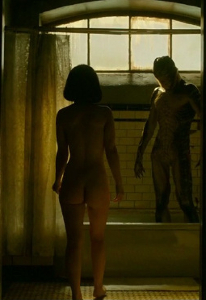
Uncut original
|
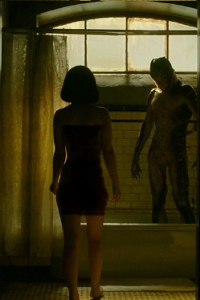
Censored Chinese version
|
Chinese audiences are used to censored, clean versions of Hollywood imports involving violence, nudity, sex scenes, or profanity. What Chinese moviegoers are allowed to see in theaters completely depends on the country's film censor, the State
Administration of Press, Publication, Radio, Film and Television of the People's Republic of China (SAPPRFT), which, in the recent release of 2017 Oscar winner The Shape of Water, altered scenes where actors are in states of undress by either adding
clothes or else pixellating out the offending details. According to a Weibo post by movie critic Feng Xiaoqiang CCC, in one scene of the Chinese revised version of the film, the female protagonist, Elisa, is covered in black shadows from her chest
to her thighs, whereas in the original, the actress is fully naked with her back facing the camera. That was my first time seeing this in a Chinese theater. I was stunned, Feng wrote. It almost looks like the actress is dressed in an all-black
one-piece swimsuit, and it fits her well. Some scenes are completely stripped from the movie, such as the opening sequence of Elisa masturbating in her tub and several sex scenes. To avoid nudity, another method used in the movie is to zoom
in the camera on the actress's face while cutting other parts of her body out of the frame. However, with the removal of a few scenes, the modified version somehow still managed to maintain the same length of 123 minutes as its original. In his
post, Feng said that since he didn't notice any replacement footage in the movie, his guess is that SAPPRFT has extended the time for opening or closing credits. Amused by the fit swimsuit that SAPPRFT forced Elisa to wear, Chinese internet users
started to dress characters in other movies to ridicule the prudishness of SAPPRFT. See these amusing examples in the
article from supchina.com |
| |
|
|
|
|
12th March 2018
|
|
|
And a little humorous criticism seems sure to warrant a police visit See article
from theglobeandmail.com |
| |
Chinese internet censor closes Weibo's trending and most searched sections
|
|
|
| 29th January 2018
|
|
| See article from scmp.com
|
China's internet censor has shut down some of the most popular sections of Weibo, a Twitter-like social media platform, saying that the website had failed in its duty to censor content. The Beijing office of the Cyberspace Administration of China
summoned a Weibo executive, complaining of its serious problems including not censoring vulgar and pornographic content. The censor said: Sina Weibo has violated the relevant internet laws and regulations and spread
illegal information. It has a serious problem in promoting 'wrong' values and has had an adverse influence on the internet environment.
It highlighted as problematic sections of the platform such as the hot topics ranking, most
searched, most searched celebrities and most searched relationship topics, as well as its question-and-answer section. Other problems on Weibo included allowing posts that discriminated against ethnic minorities and content that was not in line
with what it deemed appropriate social values. Weibo said it had since shut down a number of services, including its list of top searches, for a week. |
| |
Padmaavat banned in Malaysia
|
|
|
| 28th January 2018
|
|
| See article from
freemalaysiatoday.com |
Malaysia's film censors have banned Padmaavat , a controversial Hindi movie that features the relationship between a Hindu queen and a Muslim ruler in medieval India. The Film Censorship Board (LPF) placed the movie in its not approved list,
with a not relevant remark placed on its age rating section. The not relevant remark is usually given to banned movies deemed to likely incite hatred and uneasiness among the community. In Malaysia, Padmaavat is the second movie to get the axe
this year, following Those Long Haired Nights a Filipino movie about three ladyboy sex workers. |
| |
|
|
|
| 27th
January 2018
|
|
|
Leaked newspaper censorship orders hint at the regime's priorities, but tighter controls have made them harder to obtain. See article from thediplomat.com
|
| |
South Korea's former culture minister jailed for maintaining a blacklist of entertainers who did not support the government
|
|
|
| 24th January 2018
|
|
| See article from hollywoodreporter.com
|
South Korea's former culture minister, Cho Yoon-sun, has been sentenced to two years in jail for conspiring in a state-sponsored blacklisting of local artists and entertainment figures who did not support the country's ousted ex-president, Park
Geun-hye. Cho had previously been cleared of the offence but an appeals court in Seoul reviewed the case and found further evidence in documents from the Presidential Blue House. Cho was arrested in court and taken into immediate custody. The
notorious blacklist features nearly 10,000 artists, including the likes of Oldboy helmer Park Chan-wook, Snowpiercer actor Song Kang-ho and Man Booker Prize-winning novelist Han Kang. The blacklist was designed to deliberately exclude artists deemed
unfriendly toward Park from state-controlled support programs. Park herself was impeached and is currently in detention. The court also found Park's former chief of staff, Kim Ki-choon, to be guilty as an accomplice and had his penalty of three
years increased to four. |
|
|