 Mission
A department under the Ministry of Culture, whose mission is to protect the nation's culture and values through the process of surveillance, is on the lookout for
everything from inappropriate ringtones to promiscuously worn university uniforms.
High above Bangkok in the 18th-storey offices of Thailand's Cultural Surveillance Centre, the nation's moral monitors are hard at work.
They surf the
internet. They watch movies. They scan the pages of glossy girlie magazines in search of women that are objectionably topless.
Should they get bored, there are 40-some television screens that line the far wall and flicker with broadcasts of the
fashion channel and cable news to keep tabs on.
It is they, the Ministry of Culture's eight culture monitors, that make the calls on what to blur, block, cover with black boxes, or ban altogether.
They are the nation's censors, and it is
here, at the brazenly named centre, where they report each day on a mission to uncover cultural inappropriateness.
Just this year, they've pulled the plug on Camfrog, publicly chided the allegedly, but not actually underwearless "safety pin
dress" of aspiring actress Amy and shaken their heads at Coyote girls and the promiscuously worn university uniform.
While the Surveillance Centre has had its eye on culture and issues of national morality for a decade now, the office has
taken on new importance with widespread calls, from post-coup political leadership, the Culture Ministry to clean up the nation's morals.
Evidence and cause of the nation's "moral crisis" vary widely depending on whom you ask; blame
ranges from new technology to the Thaksin administration (which ironically founded Thailand's Moral Centre); evidence runs from the conspicuous consumption of Thai teens to the success of Thaksin's populist policies to the fact that Thailand has dipped
to 12th (of 13) in the regional corruption ratings. Meanwhile, most of the public surveyees took issue with teens wearing shoulder-baring spaghetti strap tops.
While some of these concerns may be valid, strategies to recalibrate the nation's
moral compass, so far, have been similarly scattershot and have come with the sweeping, unfocused urgency of a moral crusade.
There has been the alcohol control bill (banning advertising and lifting drinking age to 20, endorsed earlier this
week), a plan to mandate morality training for the country's senior military cadets, and a 10 p.m. Valentine's Day curfew to control the nation's sexually-eager teens.
And then there are the fast-expanding efforts of the nation's Surveillance
Centre. While the term "surveillance" carries weighty connotations of government invasiveness and freedom-curtailment in the West, the concept does not register the same concerns here.
Operating under the Ministry of Culture, the
Cultural Surveillance Centre's mission is to protect the nation's culture and values through the process of surveillance, in the words of its director, Ladda Thangsupachai, and to disseminate cultural information as a means of providing
immunity against cultural mutation; and serving as a focal point of culture monitoring network dedicated to safeguarding of Thai cultural identities, in the words inscribed on the cover of its quarterly Journal of Culture Surveillance Center.
"Surveillance" entails review of the local and foreign media, arts, film, and Internet, as well as observation of citizens and public events for insight into fashion and recreational trends. The culture monitors occasionally go further a field,
for example, on teen-watching missions to internet cafes and Ratchada, or on trips to the provinces on the lookout for Coyote girls dancing at temples.
Globalisation
 According to Ladda, threats for cultural mutation are greater than ever these days because of globalisation, the growing presence of international media and cultural imports, and developments in technologies and communications.
While she
recognises that these forces can bring "cross-cultural gifts" and other positive social change, she also believes if Thai people are not prepared for them, the nation's moral and cultural values will be (and already have been) lost or
compromised.
When the office opened 10 years ago it was a much smaller operation, and Ladda's work (she was also the director then) was concentrated almost entirely on film and pornographic video and VCDs.
With the tide of globalisation
and explosion of the Internet, though, it was realised that the the problem of culture was growing, and that the office needed to take on a much larger role. She says it became apparent that Thailand needed special protection, not just to
protect culture but to create policy to protect a new generation and develop culture to go along with the emerging world.
She says fast food typifies the effects of and the nation's relationship with imported cultures. It is delicious
and easy to consume compared to Thai food. Yet while it is convenient, in the end it is not for the best.
Ladda says surveillance efforts are targetted to guard against four particular cultural offences: inappropriate representation of
national or religious symbols, offensive language, violence, and sexual content.
Criteria for the Centre's censoring seem otherwise vague, though Ladda says the Centre usually uses public opinion as the gauge of cultural appropriateness. She adds
that in many cases, the Centre's review or investigation of a material is triggered by the complaint or tip they receive from a concerned citizen. If society shows feelings or says something is not suitable, the ministry informs the police to take
action.
As there is a lot of culture to consume for its just eight officers, the Centre has groomed a group of volunteer monitors that inform on troubling media, arts or cultural trends. Ladda hopes the Culture Surveillance Network of
500,000, which includes educators, families and high school students recruited to attend "culture camp," and then form a school morality club, will number a million by the year's end. She invites anyone to join the network.
 She says it was citizen vigilance (of parents, internet cafe owners, and even teens) that brought about the recent blocking of the website, Camfrog, a video-conferencing programme which was often used by teens in a game to broadcast genitalia, and
the banning of Inside Out! Thailand , a guidebook to Thailand's cultural quirks that its expat authors found humourous, but the Centre and at least a handful of citizens found offensive.
She says it was citizen vigilance (of parents, internet cafe owners, and even teens) that brought about the recent blocking of the website, Camfrog, a video-conferencing programme which was often used by teens in a game to broadcast genitalia, and
the banning of Inside Out! Thailand , a guidebook to Thailand's cultural quirks that its expat authors found humourous, but the Centre and at least a handful of citizens found offensive.
Yet, while the Surveillance Centre serves as a vocal
arbiter of culture, it has little authority to actually enforce its judgements and is limited to public awareness campaigns and admonishments made in national press.
Instead, the office plays an informant role, itself, taking its complaints to
the police, who have the power to confiscate and penalise distributors of offensive media; the Public Relations Department, which has the power to silence TV and radio, and to the ICT, which has the power to block internet sites.
When the Centre
has a beef with an artist or venue abroad, it tips off the Ministry of Foreign Affairs, which then parlays its concern, often through written correspondence, to the offending party. In the past, letters have been penned off to singer Christina Aguilerra
for an inappropriate music video, to the publishers of an English dictionary for defining Bangkok in terms of its sex districts, and to a number of spas and restaurants which display the Buddha inappropriately.
Patpong
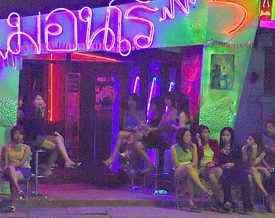 While the Surveillance Centre's eye is cast far and wide enough to scrutinise dictionaries and restaurant decor on foreign shores, their efforts interestingly steer clear of Nana, Patpong and a number of the nation's other locales which seem to teem with
scantily-clad females and bootlegged copies of censored DVDs like Team America: World Police.
While the Surveillance Centre's eye is cast far and wide enough to scrutinise dictionaries and restaurant decor on foreign shores, their efforts interestingly steer clear of Nana, Patpong and a number of the nation's other locales which seem to teem with
scantily-clad females and bootlegged copies of censored DVDs like Team America: World Police.
This, I am told, is because those places are not part of national culture, but commercial and entertainment ventures that fall under the laws,
regulations, and jurisdiction of the police. I ask whether such places have any impact on the nation's culture or morals, and she admits probably some, but says that such areas are mostly frequented by tourists and that it would be "strange" if
Thailand didn't have such a place.
She reminds me that Bangkok is not unlike other big cities: the Netherlands has Amsterdam; Singapore, it's sex shops; and America, Las Vegas. She adds that it is impossible to get rid of unless we get rid of
human desires.
Later in the conversation, though, she speaks of the time she took an exploratory trip to Patpong for work. She calls it an immoral place for tourists that do not have normal behaviours.
I ask her if it bothers her that
Thailand attracts the abnormally behaving tourist who comes to do immoral things. She blames the tour companies and the negative image perpetuated by previous tourists and foreign media, presumably like the aforementioned dictionary.
It is
Thailand's "pernicious and toxic generation" which concerns Ladda and culture watchers most. She believes Thai youth and teenagers are easily seduced and especially vulnerable to modern technologies and foreign influences.
She blames
these forces, and particularly the Internet, for having already loosened the younger generation's sexual morals, encouraged frivolous spending habits, and led to video game addictions, that she suspects will one day be linked to brain damage.
Ladda is also troubled by the trend for youth to dress fashionably, and not practically - with tendencies to turn up at movie theaters in tank tops ("dangerous" to health because of the cool theater temperatures) and to class in uniforms which are too short and too tight.
While there is little sign the Surveillance Centre's activities will be scaled back anytime soon (there is legislation in the works to hand the police authorities over to the office), Ladda says the Centre will shift its focus away from censoring
culture to rating it. Prompted by discussions with the public and her own long-thought-upon vision for stronger media regulation, the Centre helped to develop the TV rating system that was launched last December, and which will be expanded to cover film,
Internet, video games, and movie theatres in the future.
Ladda explains the media's producer will rate their product according to content (if ratings are understated, the producer will be punished), though the system certainly still comes with
touches from the heavy, moralising hand of the Culture Ministry. Reminders that this action is against morality are planned to accompany scenes involving mistresses, gambling, alcohol, smoking, and other vice.
What Gets Cut
When the Surveillance Centre encounters media or a product it finds to be culturally inappropriate, it is censored.
The extent of the censoring depends on the extent of
the offence, and in all cases must be reviewed and confirmed by a panel of experts from the government, as well as media, educational, religious, and legal fields.
 The film The King and I and buddhaporn.com , a New York-based pornographic site, are among the cultural discards for offending national and religious custom.
Cultural Surveillance Centre director Ladda Thangsupachai says
informational censorships of this kind are rare, and usually only necessary with texts from foreign authors who do not understand the cultural climate, adding that Thais usually know the bounds of appropriateness and respect them.
Most of the
public agrees with censorship of books that are not culturally appropriate. Those that want to read whatever they can want all freedoms, but have to understand they can have freedom, but it must be within the law.
She points to the local
press' sensationalism and tendencies to publish gruesome pictures and tabloid journalism, to illustrate the cultural differences in information management. Meanwhile films, television and magazines are regularly edited to guard against offensive
language, violence and sexual content.
Films frequently have scenes cut or modified. A scene involving gratuitous violence, say a gun put to a baby's head, would be cut, explains Ladda, while in other productions like 'Music and Lyrics', a
romantic comedy still in theatres, the image of a large Buddha set behind scenes of song and dance is merely blurred.
If the filmmaker is Thai, the Centre will recommend ways in which he or she can change the film, so the Centre will not have to
ban it.
Ladda says only a few films have been banned outright. Among these are City of God , an acclaimed Brazilian film, based on true events, where children engage in gratuitous violence, sex and drug-taking, and Team America: World
Police , an unacclaimed American film, where puppets engage in gratuitous violence and sex.